Monday, August 02, 2021

St Alphonsus Ligouri

 http://rachelanne25.blogspot.com/2007/08/sancta-alphonsum-mariam-ligouri.html

Reposting a post I made a long time ago: 


The Signature of St. Alphonsus Maria de Ligouri:


Today's the Feast of Saint Alphonsus Maria de Ligouri, Doctor of the Church!! One of my favourite saints, and I do really think he is one of the best spiritual writers I've ever read! As a quick search on my blog will show. His Uniformity with the Will of God, Glories of MaryThe Passion and Death of Jesus ChristThe Holy EucharistVictories of Martyrs etc. etc. a whole long list of his ascetical works - so lovingly written with a depth so infinitely beautiful ... has helped me a lot, a lot! And I cannot but Thank God and Mother Mary for one of the greatest Saints of the Church. :) Deo gratias et Mariae!


From the Collect at Mass today:

O God, Who didst kindle in blessed Alphonsus Mary, Thy Confessor and Bishop, burning zeal for the salvation of souls, and through him didst enrich Thy Church with a new offspring: grant, we beseech Thee, that imbued with his saving doctrine and strengthened by his example, we may be able happily to come to Thee. Through our Lord.

An example of one of his beautiful writings:


Affections of Love towards the Heart of Jesus

This was written by St. Alphonsus, but remained unpublished till 1875.


O amiable Heart of my Saviour! Thou art the seat of all virtues, the source of all graces, the burning furnace in which are inflamed all holy souls. Thou art the object of all God’s love; thou art the refuge of the afflicted, and the abode of the souls that love thee, O Heart worthy of reigning over all hearts, and of possessing the affection of all hearts! O Heart that was wounded for me on the Cross by the lance of my sins, and that remained afterwards continually wounded for me on the altar in the Blessed Sacrament, but not by any other lance than that of the love that thou entertainest for me! O loving Heart, that loves men with so much tenderness, and that is so little loved by men! Do thou apply a remedy to so great an ingratitude, inflame thou our hearts with a true love for thee. Ah! Why can I not go all over the world to make known the graces, the sweetness, the treasures that thou dispensest to those who truly love Thee? Accept the desire that I have of seeing all hearts burning with love for thee. O Divine Heart! Be Thou my consolation in trials, my repose in labours, my solace in anxieties, my haven in tempests. I consecrate Thee my body and my soul, my heart and my life, together with all that I am. I unite to Thine all my thoughts, all my affections, all my desires. O Eternal Father! I offer Thee the pure affections of the Heart of Jesus. If Thou dost reject mine, Thou canst not reject those of Thy Son, who is sanctity itself; may they supply what is wanting in me, and may they render me pleasing in Thy eyes!


And his love for the Blessed Virgin Mary, so - ever true, fervent and beautiful!


Here's a prayer from his book, The Holy Eucharist:


A Visit to the Blessed Virgin


(Read the visit of the day, and finish by the following prayer, thereby to obtain the most powerful patronage of Mary:)


Most holy Immaculate Virgin and my Mother Mary, to thee who art the Mother of my Lord, the Queen of the world, the advocate, the hope, the refuge of sinners, I have recourse to-day,-I, who am the most miserable of all. I render thee my most humble homages, O Great Queen, and I thank thee for all the graces thou hast conferred on me until now, particularly for having delivered me from hell, which I have so often deserved. I love thee, O most amiable Lady; and for the love which I bear thee, I promise to serve thee always, and to do all in my power to make others love thee also. I place in thee all my hopes; I confide my salvation to thy care. Accept me for thy servant, and receive me under thy mantle, O Mother of mercy. And since thou art so powerful with God, deliver me from all temptations, or rather obtain me the strength to triumph over them until death. Of thee I ask a perfect love for Jesus Christ. From thee I hope to die a good death. O my Mother, by the love which thou bearest to God, I beseech thee to help me at all times, but especially at the last moment of my life. Leave me not, I beseech thee, until thou seest me safe in heaven, blessing thee, and singing thy mercies for all eternity. Amen. So I hope. So may it be.


Mary, my mother, my hope, my refuge, to thee I recommend myself; to thee I consign my soul: pray to Jesus for me.


Read here, a very beautiful spiritual reading by St. Alphonsus Ligouri on Death. Whence death alone is our only certainty. Memento Mori!

Jesus, Mary, I love Thee; Save Souls!

Jesu mitis et humilis corde, Fac cor nostrum secundum Cor tuum. (ter)


Labels:

Wednesday, October 25, 2006

The Cross.

The Cross indeed is a treasure!
-------
Here's a little passage from St, Alphonsus Ligouri, again from his book, the Passion and Death of Jesus: It's a real good book =)
The Passion and The Death of Jesus Christ
By St, Alphonsus Ligouri
Page 112

II

St. Augustine says, there is no death more bitter than that of the cross: “Among all the different kinds of death, there was none worse.” Because, as St. Thomas observes, those who are crucified have their hands and their feet pierced through, parts which, being entirely composed of nerves, muscles, and veins, are the most sensitive to pain; and the very weight of the body itself which is suspended from them, causes the pain to be continuous and ever increasing in its intensity up to the moment of death.

But the pains of Jesus were far beyond all other pains for, as the Angelic Doctor (St. Thomas Aquinas) says, the body of Jesus Christ being perfectly constituted, was more quick and sensitive to pain – that body which was fashioned for him by the Holy Spirit, expressly with a view to his suffering as he had foretold; as the Apostle testifies, A body thou hast fitted to Me.- Heb. X.5. Moreover, St. Thomas says that Jesus Christ took upon himself an amount of suffering so great as to be sufficient to satisfy for the temporal punishment merited by the sins of all mankind. Tiepoli tells us that, in the crucifixion, there were dealt twenty-eight strokes of the hammer upon his hands, and thirty-six upon his feet.

O my soul, behold thy Lord, behold thy life, hanging upon that tree: And thy life shall be, as it were, handing before thee.-Deut. Xxviii.66 Behold how, on that gibbet of pain, fastened by those cruel nails, he finds no place of rest. Now he leans his weight upon his hands, now upon his feet; but on what part soever he leans, the anguish increases. He turns his afflicted head, now on one side, now on the other: if he lets it all towards his breast, the hands, by the additional weight, are rent the more; if he lowers it towards his shoulders, the shoulders are pierced with the thorns; if he leans it back upon the cross, the thorns enter the more deeply into the head.

Ah, my Jesus, what a death of bitterness is this that Thou art enduring! O my crucified Redeemer, I adore Thee on this throne of ignominy and pain. Upon this cross I read it written that Thou art a king: Jesus of Nazareth, King of the Jews – J.N.R.J. – John, xix. 19. But apart from this title of scorn, what is the evidence that Thou dost give of being a king? Ah, these hands transfixed with nails, this head pierced with thorns, this throne of sorrow, this lacerated flesh, make me well know that Thou art king, but king of Love! With humility, then, and tenderness do I draw near to kiss Thy sacred feet, transfixed for love of me; I clasp in my arms this cross, on which Thou, being made a victim of love, wast willing to offer Thyself in sacrifice for me to the divine justice: being made obedient unto death, the death of the cross – Phil.ii.8. O blessed obedience which obtained for us the pardon of our sins! And what would have become of me, O my Saviour hadst Thou not paid the penalty for me! I thank Thee O my love, and by the merits of this sublime obedience do I pray Thee to grant me the grace of obedience in everything to the divine will. All that I desire paradise for is, that I may love Thee forever, and with all my strength.
-------
O Most Loving Mother Mary, please help me!
-------
-------
Another good book by St, Alphonsus Ligouri, that I recommend reading would be his

Thursday, August 02, 2007

Sancta Alphonsum Mariam Ligouri

The Signature of St. Alphonsus Maria de Ligouri:


Today's the Feast of Saint Alphonsus Maria de Ligouri, Doctor of the Church!! One of my favourite saints, and I do really think he is one of the best spiritual writers I've ever read! As a quick search on my blog will show. His Uniformity with the Will of God, Glories of Mary, The Passion and Death of Jesus Christ, The Holy Eucharist, Victories of Martyrs etc. etc. a whole long list of his ascetical works - so lovingly written with a depth so infinitely beautiful ... has helped me a lot, a lot! And I cannot but Thank God and Mother Mary for one of the greatest Saints of the Church. :) Deo gratias et Mariae!


From the Collect at Mass today:

O God, Who didst kindle in blessed Alphonsus Mary, Thy Confessor and Bishop, burning zeal for the salvation of souls, and through him didst enrich Thy Church with a new offspring: grant, we beseech Thee, that imbued with his saving doctrine and strengthened by his example, we may be able happily to come to Thee. Through our Lord.

An example of one of his beautiful writings:


Affections of Love towards the Heart of Jesus

This was written by St. Alphonsus, but remained unpublished till 1875.


O amiable Heart of my Saviour! Thou art the seat of all virtues, the source of all graces, the burning furnace in which are inflamed all holy souls. Thou art the object of all God’s love; thou art the refuge of the afflicted, and the abode of the souls that love thee, O Heart worthy of reigning over all hearts, and of possessing the affection of all hearts! O Heart that was wounded for me on the Cross by the lance of my sins, and that remained afterwards continually wounded for me on the altar in the Blessed Sacrament, but not by any other lance than that of the love that thou entertainest for me! O loving Heart, that loves men with so much tenderness, and that is so little loved by men! Do thou apply a remedy to so great an ingratitude, inflame thou our hearts with a true love for thee. Ah! Why can I not go all over the world to make known the graces, the sweetness, the treasures that thou dispensest to those who truly love Thee? Accept the desire that I have of seeing all hearts burning with love for thee. O Divine Heart! Be Thou my consolation in trials, my repose in labours, my solace in anxieties, my haven in tempests. I consecrate Thee my body and my soul, my heart and my life, together with all that I am. I unite to Thine all my thoughts, all my affections, all my desires. O Eternal Father! I offer Thee the pure affections of the Heart of Jesus. If Thou dost reject mine, Thou canst not reject those of Thy Son, who is sanctity itself; may they supply what is wanting in me, and may they render me pleasing in Thy eyes!


And his love for the Blessed Virgin Mary, so - ever true, fervent and beautiful!


Here's a prayer from his book, The Holy Eucharist:


A Visit to the Blessed Virgin


(Read the visit of the day, and finish by the following prayer, thereby to obtain the most powerful patronage of Mary:)


Most holy Immaculate Virgin and my Mother Mary, to thee who art the Mother of my Lord, the Queen of the world, the advocate, the hope, the refuge of sinners, I have recourse to-day,-I, who am the most miserable of all. I render thee my most humble homages, O Great Queen, and I thank thee for all the graces thou hast conferred on me until now, particularly for having delivered me from hell, which I have so often deserved. I love thee, O most amiable Lady; and for the love which I bear thee, I promise to serve thee always, and to do all in my power to make others love thee also. I place in thee all my hopes; I confide my salvation to thy care. Accept me for thy servant, and receive me under thy mantle, O Mother of mercy. And since thou art so powerful with God, deliver me from all temptations, or rather obtain me the strength to triumph over them until death. Of thee I ask a perfect love for Jesus Christ. From thee I hope to die a good death. O my Mother, by the love which thou bearest to God, I beseech thee to help me at all times, but especially at the last moment of my life. Leave me not, I beseech thee, until thou seest me safe in heaven, blessing thee, and singing thy mercies for all eternity. Amen. So I hope. So may it be.


Mary, my mother, my hope, my refuge, to thee I recommend myself; to thee I consign my soul: pray to Jesus for me.


Read here, a very beautiful spiritual reading by St. Alphonsus Ligouri on Death. Whence death alone is our only certainty. Memento Mori!

Jesus, Mary, I love Thee; Save Souls!

Jesu mitis et humilis corde, Fac cor nostrum secundum Cor tuum. (ter)

Labels:

Sunday, August 12, 2007

Uniformity with God's Will

Sit nomen Domini benedictum ex hoc nunc et usque in saeculum- Psalm 112:2

Today's the 11th Sunday after Pentecost. And Fr.'s sermon was on the Thy will be done part of the Pater noster. It reminds me again, of one of my favourite works of dear Saint Alphonsus Ligouri on Uniformity With God's Will. Here's a link to something that I posted a year ago, also from this same book, that sincerely melted this hard heart of mine :)


------------- (excerpt from the abovementioned link)


This is taken from page 13 of St. Alphonsus Ligouri's book, Uniformity with God's Will, translated from the Italian of the Saint, by Thomas W. Tobin, C.S.S.R.


The devout Father John Tauler relates this personal experience: For years he had prayed God to send him someone who would teach him the real spiritual life. One day, at prayer, he heard a voice saying: "Go to such and such a church and you will have the answer to your prayers." He went and at the door of the church he found a beggar, barefooted and in rags. He greeted the mendicant saying:


"Good day, my friend."


"Thank you, sir, for your kind wishes, but I do not recall ever having had a 'bad' day."


"Then God has certainly given you a very happy life."


"That is very true, sir. I have never been unhappy. In saying this I am not making any rash statement either. This is the reason: When I have nothing to eat, I give thanks to God; when it rains or snows, I bless God's providence; when someone insults me, drives me away, or otherwise mistreats me, I give glory to God. I said I've never had an unhappy day, and it's the truth, because I am accustomed to will unreservedly what God wills. Whatever happens to me, sweet or bitter, I gladly receive from his hands as what is best for me. Hence my unvarying happiness."


"Where did you find God?"


"I found him where I left creatures."


"Who are you anyway?"


"I am a king."


"And where is your kingdom?"


"In my soul, where everything is in good order; where the passions obey reason, and reason obeys God."


"How have you come to such a state of perfection?"


"By silence. I practice silence towards men, while I cultivate the habit of speaking with God. Conversing with God is the way I found and maintain my peace of soul."


Union with God brought this poor beggar to the very heights of perfection. In his poverty he was richer than the mightiest monarch; in his sufferings, he was vastly happier than worldlings amid their worldly delights.
---


This IS the answer to true happiness!


A good priest (God Bless His Soul!) told this to me once, (or to this extend the way I remember it) in order to hear/listen to God, and let God enter into your soul, you need to be rid of worldly affections, rid of things that will cause God to be separated from you .. (etc)


Reading that particular page from St. Alphonsus's book and remembering what the good priest told me, I was compelled to put this up.


------------- (end of excerpt from that post a year ago) :)

"Perfection is founded entirely on the love of God: "Charity is the bond of perfection;" and perfect love of God means the complete union of our will with God's."


- Saint Alphonsus Maria de Ligouri

The Proper of the Mass today says so much, so beautifully ...

From the Collect of today's Holy Mass:

Almighty and everlasting God, Who in the abundance of Thy kindness art wont to go beyond our merits and our prayers: pour down Thy mercy on us: forgive us aught whereof our conscience is afraid, and grant us all we dare not ask in prayer. Through Christ our Lord.

The last part of the Epistle of today's Holy Mass (I Cor. 15:10):

But by the grace of God I am what I am; and His grace in me hath not been void.
Gratia autem Dei sum id, quod sum, et gratia ejus in me vacua non fuit.

From the Gradual of today's Holy Mass (Ps. 27:7,1):

In God hath my heart confided, and I have been helped; and my flesh hat flourished again; and with my will I will give praise to Him. Unto Thee have I cried, O Lord: O my God, be not Thou silent: depart not from me.

From the Communion of today's Holy Mass (Prov. 3:9,10):

Honour the Lord with thy substance, and with the first of all thy fruits: and thy barns shall be filled with abundance, and thy presses shall run over with wine.

Deus propitius esto mihi peccatori!

Jesus, Mary, I love Thee; Save Souls!

Jesu mitis et humilis corde, Fac cor nostrum secundum Cor tuum. (ter)

Labels: ,

Friday, August 02, 2013

St Alphonsus Ligouri, Ora pro nobis!

Today is the Feast Day of St Alphonsus Ligouri and also First Friday. Some thoughts on what I have been thinking and meditating about this last week:

St Joseph - no rash judgments (I will elaborate on this)

When inner struggles weigh you down, my dearest Jesus, stay with me. Help me always to remember:

Deus propitius esto mihi peccatori!

and this:


St Thomas speaks in IIa IIae qu. 60 a.3: “this [interpreting doubts in the evil side] is due to a man being ill-disposed towards another: for when a man hates or despises another, or is angry with or envious of him, he is led by slight indications to think evil of him, because everyone easily believes what he desires. 


Deus propitius esto mihi peccatori

Jesu mitis et humilis corde, Fac cor nostrum secundum Cor tuum. (ter)

Jesus, Mary, Joseph, Anne, Therese, Alphonsus, I love You; Save Souls!

Labels: , , , ,

Sunday, November 12, 2006

From my favourite saint, my heavenly patron .. St. Thérèse!

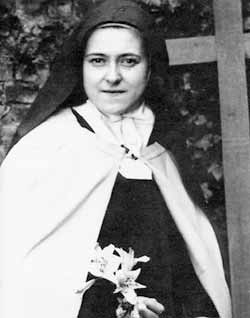
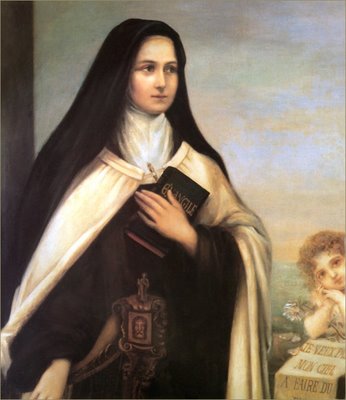
I'd like to take some time off my work to write a little on my favourite heavenly patron, Dearest Saint Thérèse of Lisieux, whose name was Sister Thérèse of the Child Jesus and Holy Face.
I have a book on Saint Thérèse, providentially given to me by a very good priest,
it is titled St Thérèse of Lisieux By Those Who Knew Her edited and translated by Christopher O Mahony, its basically a compilation from testimonies submitted by various blessed people, who knew St Thérèse, taken from the process of her beatification. The whole book is a real treasure! especially on the Saint herself and insights on various aspects of her 24 year, most beautiful life on earth. =) Deo gratias et Mariae!

A question one can ask is: Why do I want to study a Saint's life so intimately?
The Answer that is given says this - and this is true wisdom: The Saints are definitely in heaven and they are there already because of their very saintly lives - they imitated Christ, and attained very high levels of perfection. Studying a Saint's life is like reading a score from which music is played and interpreted. The music here being how your life should be lived. A Saint's life is like a manuscript from which we can imitate and from which we can draw on the fruits of living a saintly life here on earth, so that we may, in our stead too, attain the very end that we were called to fufill, paradise for eternity, praising and loving God in saecula saeculorum.

Saint Thérèse in a popular representation.

Here's an excerpt from a testimony by Sister Marie-Joseph of the Cross, O.S.B. who was the maid and governess under the service of M. Guerin, St Thérèse's uncle, before she joined the Benedictine nuns of the Blessed Sacrament at Bayeaux. She was the 8th witness and she testified this on 12-15 December 1910.

"Shortly after her first communion, when she was about twelve, she used to talk to me about God: how good he was to those who loved him, the love he bore each of us individually. As I did not feel all that much love for him, and said as much to her, she explained that love was not a matter of what you felt but of practising virtue, and that we should always try to please God in the least of our actions, without any attempt to draw attention to ourselves."

When the witness, Marcelline, before she became a nun, told St Thérèse that she intended to become a nun, St Thérèse told her this:

"we must always Love God a great deal, and to prove that love we must make all the sacrifices he asks of us. Don't worry, I'll be praying for you. Love God so that you won't be too afraid of him; he is so kind, really! Remember too to pray for those who do not love him, so that we can convert many souls."

As such, love of God equates love of sacrifice. The true definition of love is:

Love = Sacrifice

Love and Sacrifice are 2 things so interconnected, they cannot be separated. If you say you love someone, you say that you are willing to give your life for that someone.

And, how beautiful that love is, so gentle, so warm, so tender, so infinite, that He would give up his life, hanging on something most disgusting, in order to bear the burden of our sins, our iniquities? And as I posted up a few months ago, in July,

-Whosoever on earth would endure all that, just to cleanse us of our iniquity?-

None other than the greatest love of All - Jesus.

I am now reminded of a paragraph I read some time ago in St Alphonsus Ligouri's book on The Passion and the Death of Jesus Christ.

(This is taken from Chapter 1: The Love of Jesus Christ in being willing to satisfy the Divine Justice for our sins.)

I.

We read in history of a proof of love so prodigious that it will be the admiration of all ages.

There was once a king, lord of many kingdoms, who had one only son, so beautiful, so holy, so amiable, that he was the delight of his father, who loved him as much as himself. This young prince had a great affection for one of his slaves; so much so that, the slave having committed a crime for which he had been condemned to death, the prince offered himself to die for the slave; the father, being jealous of justice, was satisfied to condemn his beloved son to death, in order that the slave might remain free from the punishment that he deserved: and thus the son died a malefactor's death, and the slave was freed from punishment.

This fact, the like of which has never happened in this world, and never will happen, is related in the Gospels, where we read that the Son of God, the Lord of the universe, seeing that man was condemned to eternal death in punishment of his sins, chose to take upon himself human flesh, and thus to pay by his death the penalty due to man: He was offered because it was His own will - Isa. liii. 7.

And his Eternal Father caused him to die upon the cross to save us miserable sinners: He spared not His own Son, but delivered Him up for us all. - Rom. viii.32 .

What dost thou think, O devout soul, of this love of the Son and of the Father?

Thou didst, then, O my beloved Redeemer, choose by Thy death to sacrifice Thyself in order to obtain the pardon of my sins. And what return of gratitude shall I then make to Thee? Thou hast done too much to oblige me to love Thee; I should indeed be most ungrateful to Thee if I did not love Thee with my whole heart. Thou hast given for me Thy divine life; I, miserable sinner that I am, give Thee my own life. Yes, I will at least spend that period of life that remains to me only in loving Thee, obeying Thee, and pleasing Thee.

-------

St Alphonsus Ligouri's writings are fabulous!! =) don't you agree? =)

and here's a link to one of the books I was blogging about in my previous post, its a really really really good book! =)

The Mystical City of God by Venerable Mary of Agreda

-------

Jesus, Mary, I love Thee, Save Souls!

Wednesday, March 07, 2007

Wednesday in 2nd Week of Lent, Sancte Thomas Aquinas!

Today's the commemoration of the Feast of St. Thomas Aquinas, being in the 2nd week of Lent.

Here's a little more about St. Thomas Aquinas:

J.M.J.

St. Thomas Aquinas (1225 - 1274)

St. Thomas Aquinas was born in 1225, in the Castle of Rocca Secca, high up in the mountains near the town of Aquinas, in Italy. His Father was Count of Aquinas and his Mother was Countess.

Before St. Thomas was born, a holy hermit known as Buono, went to the Castle of Rocca Secca and made a great prophecy to his Mother. While speaking to the Countess he pointed to a picture of St. Dominic, saying, "Lady be glad, for you are about to have a son whom you will call Thomas. You and your husband will think of making him a monk in the Abbey of Mount Cassino (Benedictines), where lies the founder, St. Benedict, in the hopes that your son will attain to its honours and wealth. But God has disposed otherwise, because he will become a Friar of the Order of Preachers (Dominicans). And so great will be his learning and sanctity, that there will not be found in the whole world, another person like him!"
Countess Theodora was amazed at the prophecy and falling on her knees exclaimed, "I am most unworthy of bearing such a son, but God's will be done according to His good pleasure!"
A few miles to the south of Rocca Secca, stands the Abbey of Mount Cassino. From the age of five to about the age of thirteen, Thomas went to school there. The Benedictine Monks liked his modest, sweet and gentle nature. They realized that Thomas had special talents and virtues, and encouraged his Father to send him to University.
Thomas was brought home from Mount Cassino for a short vacation, before going to University. At home Thomas did not become spoiled, because the Monks had trained him well. He remained the same gentle boy: serious, studious, and prayerful. His greatest delight was to give alms to the poor. He even gave his own food to the poor! The Countess feared that Thomas might loose his innocence at University but his Father thought differently, and sent him to the University of Naples. His only joy was study and prayer. He really wanted to become a saint and longed to give himself more completely to God. Gradually the desire grew in his heart, to join the Dominicans. As soon the Count heard about his son's plans, he commanded Thomas to put the idea out of his head. But Thomas had his mind made up to do the Holy Will of God, so one day when he was seventeen, he took the habit in the Dominican Monastery of Naples.

His Mother used tears, promises and threats, to make her son leave the Dominicans but Thomas had made up his mind to remain in the Order. He was then imprisoned in one of the castle towers, where he had to suffer cold and hunger, and had to do without many things. Thomas was kept a prisoner for over one year, and during this time, he memorized the whole Bible as well as the four books of the "Sentences", (Theological textbook of the time).

When Thomas' two brothers came home from the army, they decided to teach their brother a lesson. They sent an evil woman into the tower to tempt him towards sin! But Thomas grabbed a piece of burning wood from the fireplace, and drove the wicked woman from the tower. He then traced a cross upon the wall with the burning wood and kneeling down, begged God to grant him the gift of Purity until his death. Suddenly, Thomas went into ecstasy! Two Angels appeared and tied a cord tightly around his waist saying, "We have come from God to give you this cord of Chastity and God has heard your prayer. God has granted you the gift of Purity until your death!" This cord, which was worn by St. Thomas until his death, is now kept as a relic, in the Monastery of Chieri in Piedmont, Italy.

After a year or two passed, the Pope and Emperor learned about Thomas. They were very displeased at the way he had been treated. At last the Countess became more merciful. The Dominicans came to rescue Thomas, and one of his sister's helped him to escape by letting him down in a basket, from the tower. In 1244, the General of the Dominican Order took Thomas to Cologne, Germany, where St. Albert Magnus was teaching. Thomas gave full attention to his studies, seeking to learn all he could for the greater honour and glory of God. He even went without sleep, in order to have more time to study his books.Because of his humility, St. Thomas hid his learning from others. But one day St. Albert found a paper that Thomas had written, explaining the answer to a very difficult question. The next day, Albert asked Thomas some questions in public and then exclaimed, "We call Br. Thomas the Dumb Ox! But I tell you that one day he will make his bellowing (loud voice), heard through the whole world!" In 1245, St. Albert went to the University of Paris, to obtain the Degree of Doctor, taking St. Thomas along as his companion. They set out on foot and in time reached the Dominican Monastery of St. James, in Paris. Here, St. Thomas became the model of the whole Monastery because of his deep Humility, his Spirit of Prayer, his perfect Obedience, and his great Charity. Heavenly grace glowed from St. Thomas, and some said they only had to look at him to become more fervent!

In Paris, St. Thomas met another holy monk known now as St. Bonaventure, who was a Franciscan. They studied together for three years and became the closest of friends. They both obtained the Degree of Bachelor of Theology in 1248.In November 1248, Albert went back to Cologne and took St. Thomas with him.

Thomas became a teacher under the direction of St. Albert, and the new school in Cologne soon overflowed with students. Thomas always used these five basic ideals, when he was teaching; (1) Clearness (2) Brevity {Short} (3) Utility {Useful} (4) Sweetness (5) Maturity {Complete}.

Soon after his return to Cologne, Thomas became a priest. He became yet closer to the good God, and spent many hours of the day and night, praying in Church. He loved God so much, that he would shed many tears while saying Holy Mass. In 1252, St. Thomas was ordered by the General Chapter (special meeting) to go to Paris to obtain his degree as a Doctor. In those days, one had to be at least thirty-five to teach Theology, but his learning was so extraordinary, that he was allowed to be a Professor at twenty-five. When he was in Paris, his success in teaching was so great, that crowds of people came to the Monastery of St. James to hear him. Later on St. Thomas and St. Bonaventure were asked to defend the truths of the Faith in the Papal Courts, because someone had written a heretical book. They were victorious and on October 23, 1257, both monks received their Doctor's degree.St. Thomas taught in Rome for a while and in 1269, he went to Paris to teach. At the time, here was a disagreement among the Doctors at the University, about the Holy Eucharist. They presented their questions to Thomas. After praying for a long time about the question, he wrote his opinion on paper. In great Humility he brought it to the Church and laid it on the Altar of the Blessed Sacrament. Thomas then prayed, "Lord Jesus, Who art truly present and who works wonders in the adorable Sacrament, I beg Thee, if I have written the truth, please enable me to teach it. But if some of the things I have written are not true, then please do not allow me to talk about it." Then the Monks who were watching, saw Our Lord Himself come down and stand upon the written paper, They heard Jesus say these words: "Thomas, thou hast written well concerning the Sacrament of My Body." St. Thomas suddenly went into ecstasy! His soul was filled with joy and he floated in the air, eighteen inches above the ground! In 1271, St. Thomas returned to Italy and began to teach in Rome. During the following Holy Week he preached in St. Peter's on the Passion of Our Lord, and those who heard him were moved to tears, and cried until Easter Sunday. And at Easter, a miracle took place when a sick woman kissed the hem of his mantle, and was immediately cured! The whole soul of St. Thomas was filled with love for the Holy Eucharist. He only wanted God, and one day as he was praying at Naples after he had finished writing the first part of the Summa, Jesus spoke from the Crucifix: "Thou hast written well of me, what recompense dost thou desire?" Thomas humbly answered, "None other than Thyself, O Lord." He wished to continue having Our Lord, as his greatest love forever! One of his fellow Dominican's once asked him, what he considered to be the greatest gift that God had given him after Sanctifying grace itself. After a few moments St. Thomas replied: "I think that of having understood whatever I have read." He had an ability to remember all that he heard, so that his mind was like a well stocked library. On December 6, 1273, St. Thomas stopped writing. That day while saying Mass, he went into ecstasy and received a revelation. Fr. Reginald urged Thomas to continue to write, but he replied, "The end of my labours is come. All that I have written appears to me as so much straw, after the secrets that have been revealed to me! I hope in the Mercy of God that the end of my life may soon follow the end of my labours." He wanted to give himself entirely to God and prayer. St. Thomas was suffering from some illness, when he was ordered by Pope Gregory X to attend the General Council at Lyons, France. The purpose of the Council was to unite the Greek and Latin Churches. So on January 28, 1274, Thomas set out with some of his Dominican Brothers. On the way his condition became much worse, and he was taken to the home of his niece. However, the Cistercian Monks of Fossa Nuova urged Thomas to come to their Monastery. Upon arrival at the Monastery, St. Thomas went straight to the Church, to adore Jesus. Thomas was very ill for a month. During this time, the monks were very kind to him. There was no hope for the holy monk to get better, so he made his General Confession. He then received the Last Rites and when Holy Communion was brought to him, tears came to his eyes as he made this Profession of Faith. "I firmly believe Jesus Christ, True God and True Man, Son of God and Son of the Virgin Mary, is in this Sacrament. I receive Thee the price of my Redemption, for whose love I have watched, studied and laboured, preached and taught." He died a little after midnight March 7, 1274.

SUMMARY:

The teaching in philosophy and theology as developed by St. Thomas Aquinas is called Thomism. His philosophy is known as Scholastic philosophy. St. Thomas had a special talent for bringing together human knowledge from the best of sources that had gone before him. Using human reason, this saint helped the Church come to profound conclusions as to understanding in greater depth the true faith of the Church. He teaches us all this necessity to love the truth, to seek it and to put it into practices. Holiness in the mind of St. Thomas was nothing other than the love of God put into practice. In other words, the living out of the reality or truth that we have to come to learn. While faith is a free gift of God, nevertheless faith and reason are two different ways of realizing the knowledge of truth. By using reasoning correctly, we can arrive at a greater understanding of the true faith given us by God. St. Without a correct use of reason, such as shown us by St. Thomas Aquinas, members of the Church can become confused as to what is true faith. Thomas Aquinas did much for the Church, and his work is still of great value today. The authority of the Church exercised by Popes and Church Councils has repeatedly stated that the clear principles of St. Thomas, which give us a solid grasp of both faith and reality, should be what guides us in the education and formation of students.

--------------------------------------

In the 1962 missal, St. Thomas Aquinas' feast day is celebrated on March 7, the day of his death.
OLRL offers the 37 page booklet "St. Thomas Aquinas - Universal Doctor of the Church" (olrl.org/books/auinas.shtml) for 65 cents ea.
Please review our catalog/order form at olrl.org/library/oform.shtml.

-------

Here's a link from the St. Thomas Aquinas Seminary, SSPX, with a very good flash intro I like very much. :)

oh Sancte Thomas Aquinas, ora pro nobis!

Deo gratias et Mariae! :)
-------
From The Passion and Death of Jesus Christ by St. Alphonsus Ligouri:


The fall of Peter, who denied Him, and even swore that he never knew Him, added to the sufferings of Jesus. Go, my soul, go to that prison where my Lord is sorrowful, mocked, and abandoned; thank Him and console Him by thy repentance, for thou also hast despised and derided Him. Tell Him that thou wouldst wish to die of sorrow, at the thought of having hitherto caused so much bitterness to the sweet heart of a God who has loved thee so tenderly. Tell Him that now thou dost love Him, and dost desire nothing else than to suffer and die for the love of Him.

Ah, my Jesus, forget all the displeasure that I have given Thee, and look on me with that love with which Thou didst look on Peter after he denied Thee; after the look which Thou didst then cast upon him, he did not cease to bewail his sin until he ceased to live. O great Son of God, O Infinite Love, who dost suffer for the very men who hate and maltreat Thee, Thou art the glory of paradise; Thou wouldst have done great honour to men by merely permitting them to kiss Thy feet. But, O God! What has reduced Thee to such a degree of ignominy as to become the sport of the vilest rabble? Tell me, O my Jesus, what I can do in order to compensate the honour which Thy enemies take from Thee by their insults and reproaches. I hear Thee answer: Bear insults for my sake, as I have borne them for the love of thee. Yes, my Redeemer, I wish to obey Thee. My Jesus, despised for the love of me, I am willing, and desire to be despised for Thee as much as Thou pleasest.

Oh dearest Mary, my Mother, all ye Angels and Saints please pray for me!

Amor meus crucifixus est!

Parce Domini, Parce populo tuo: ne in aeternum irascaris nobis.
Have a good LENT!

Labels: , ,

Tuesday, May 01, 2007

St. Catherine of Sienna (one day late)

... Whoosh, and time does fly since the exams have ended. (lol) :) I'm back.
Here's something that I wanted to post yesterday but was too exhausted to do so. Hence, the title of the post, (yesterday's feast day of St. Catherine de Sienna (one day not too late)) :)
It's from my favourite book by St. Alphonsus Ligouri, on the Passion and Death of Jesus Christ:

St. Alphonsus de Ligouri’s
The Passion and the Death of Jesus Christ

Pg 411
Second Meditation – The Great Obligation by which we are Bound to love Jesus Christ

Forget not the kindness of thy surety; for He hath given His life for thee (Gratiam fidejussoris ne obliviscaris; dedit enim pro te animam suam) – Ecclus. Xxix. 20. By this surety, commentators commonly understand Jesus Christ, who, seeing that we were unable to atone to the divine justice, offered Himself because it was His own will. (Oblatus est, quia ipse voluit) – Isa. Liii.7. He offered to make satisfaction for us, and He actually paid our debts by His blood and by His death. He hath given His life for thee.

To repair the insults which we offered to the divine majesty, the sacrifice of the life of all men was not sufficient: God alone could atone for an injury done to a God; and this Jesus Christ has accomplished. By so much, says St. Paul, is Jesus made a surety of a better testament. (In tantum melioris testamenti sponsor factus est Jesus) – Heb. Vii. 22. By making satisfaction, as his surety, in behalf of man, our Redeemer, says the Apostle, obtained by His merits a new compact, - that if man should observe the law, God would grant him grace and eternal life. This is precisely what Jesus Christ himself expressed in the institution of the Eucharist when He said, This chalice is the new testament in my blood. (Hic calix novum testamentum est in meo sanguine) – I Cor. Xi.25. By these words He meant, that the chalice of His blood was the instrument or written security by which was established the new covenant between God and Jesus Christ, that to men who were faithful to Him should be given the gift of grace and of eternal life.

Hence, by suffering the penalties due to us, the Redeemer, through the love which He bore us, made in our behalf a rigorous atonement to the divine justice. Surely, says he Prophet, He hath borne our infirmities, and carried our sorrows. (Vere languores nostros ipse tulit, et Dolores nostros ipse portavit.) – Isa. Liii, 4. And all this was the fruit of His love. Christ hath loved us, and hath delivered Himself for us. (Dilexit nos, et tradidit semetipsum pro nobis) – Eph. V.2. St. Bernard says that to pardon us, Jesus Christ has not pardoned Himself. “To redeem a slave He spared not Himself.” (Ut servum redimeret, sibi Filius ipse non pepercit.) O miserable Jews, why do you wait for the Messiah promised by the Prophets? He has already come: you have murdered Him; but, in spite of your guilt, your Redeemer is ready to pardon you; for He has come to save the lost sheep of the house of Israel: The Son of Man came to save that which was lost. (Venit enim Filius hominis salvare quod perierat) – Matt. Xviii.II.

St. Paul has written that, to deliver us from the malediction due to our sins, Jesus Christ has charged Himself with all the maledictions which we merited; and therefore He wished to suffer the death of the accursed, that is, the death of the cross: Christ hath redeemed us from the curse of the law, being made a curse for us; for it is written, Cursed is every one that hangeth on a tree. (Christus nos redemit de maledicto legis, factus pro nobis maledictum: quia scriptum est: Maledictus omnis qui pendet in lingo.) – Gal. iii.13.

What a source of glory would it be to a poor peasant, captured by pirates, and reduced to slavery, to be ransomed by his sovereign at the cost of a kingdom! But how much greater glory do we derive from having been redeemed by Jesus Christ at the expense of His own blood, a single drop of which is worth more than a thousand worlds! You were not redeemed with corruptible things as gold or silver, … but with the precious blood of Christ, as of a lamb unspotted and undefiled. (Non corruptibilibus auro vel argento redempti estis … sed pretioso sanguine quasi Agni immaculati Christi.) – 1 Pet. i.18,19. Hence, St. Paul tells us that we commit an act of injustice against our Saviour if we dispose of ourselves according to our own, and not according to His, will, or if we reserve anything to ourselves, or, what is worse, if we indulge our inclinations so as to offend our God. For we belong not to ourselves, but to Jesus Christ who has purchased us with a great price. Know you not that … you are not your own? For you are bought with a great price. (An nescitis quoniam … non estis vestri? Empti enim estis pretio magno.) – 1 Cor. Vi. 19,20.

Ah, my Redeemer, if I had shed all my blood for Thee, and even given for Thee a thousand lives, what compensation would it be for the love of Thee, who hast given Thy blood and Thy life for me? Give me strength, O my Jesus, to be entirely Thine during the remainder of my life.

Mary, my Mother, my Hope after Jesus, please pray for me and intercede for me.

Dearest Angels and Saints, please guide me and help me.

Ad Majorem Dei Gloriam!

Jesus, Mary, I love Thee, Save Souls!

Regina Caeli, Laetare, Alleluia!

Labels: ,

Wednesday, September 05, 2007

A Visit to the Blessed Sacrament

Et erunt oculi mei et cor meum ibi cunctis diebus. – 3 Kings, ix. 3.


Here's a beautiful, very beautiful visit to the Blessed Sacrament written by St. Alphonsus Ligouri:

13th Visit to the Blessed Sacrament
By St. Alphonsus Maria de Ligouri

My eyes and my heart shall be there always. (Et erunt oculi mei et cor meum ibi cunctis diebus. – 3 Kings, ix. 3.)

Behold, Jesus has verified this beautiful promise in the Sacrament of the Altar, wherein he dwells with us night and day.

My Lord, would it not have been enough hadst Thou remained in this Sacrament only during the day, when Thou couldst have had adorers of Thy presence to keep Thee company; but why remain also the whole night, when the churches are all closed, and when men retire to their homes, leaving Thee quite alone? Ah, yes! I already understand Thee: love has made Thee our prisoner; the excessive love which Thou bearest us has so bound Thee down on earth, that neither night nor day canst Thou leave us. Ah, most amiable Saviour, this refinement of love alone should oblige all men ever to stay with Thee in the sacred ciboriums, and to remain with Thee until forcibly compelled to leave Thee; and when they do so, they should all leave at the foot of the altar their hearts and affections inflamed with love towards an Incarnate God, who remains alone and enclosed in a tabernacle, all eyes to see and provide for them in their necessities, and all heart to love them, and who awaits the coming day to be again visited by his beloved souls.

Yes, my Jesus, I will please Thee; I consecrate my whole will and all my affections to Thee. O infinite Majesty of God, Thou hast left Thyself in this divine Sacrament, not only that Thou mightest be present with us and near us, but principally to communicate Thyself to Thy beloved souls. But, Lord, who will presume to approach Thee to feed upon Thy flesh? And who, on the other hand, can keep a distance from Thee? Or this purpose Thou concealest Thyself in the consecrated Host, that Thou mayest enter into us and possess our hearts. Thou burnest with the desire of being received by us, and Thou rejoicest in being there united with us. Come, then, my Jesus, come; I desire to receive Thee within myself, that Thou mayest be the God of my heart and of my will. All that is within me I yield, my dear Redeemer, to Thy love; satisfactions, pleasures, self-will, all I give up to Thee. O Love, O God of love, reign, triumph over my entire self; destroy and sacrifice all in me which is mine and not Thine. Permit not, O my Love, that my soul, which, having received Thee in the Holy Communion, is filled with the Majesty of God, should again attach itself to creatures. I love Thee, my God, I love Thee; and I will love Thee alone and forever.

Ejaculatory Prayer: Draw me by the chains of Thy love! (Trahe me vinculis amoris tui.)

A Visit to Mother Mary

St. Bernard exhorts us, saying: “Let us seek for grace, and let us seek it by Mary.” “She”, says St. Peter Damian, “is the treasure of divine graces.” She can enrich us, and she desires to do so. She therefore invites and calls us, saying: Whosoever is a little one, let him come to me. Most amiable Lady, most exalted Lady, most gracious Lady, look on a poor sinner who recommends himself to Thee, and who places all his confidence in Thee.

Ejaculatory Prayer: We fly to thy patronage, O holy Mother of God!

Prayer of St. Ildefonsus

Most humble handmaid of thy divine Son! I prostrate myself before thee, conjuring thee to obtain pardon of my sins, that I may be cleansed from all the imperfections of my life. I entreat thee to procure me the grace of being always united to God and to thee, and to be ever a faithful servant of thy Son and of thee: of thy Son, as my Lord and my Redeemer; and of thee, as the cause of my redemption: for if he has paid the price of my redemption, it was with the body which he received from thee.

Ejaculatory Prayer: O Mary! Obtain for me confidence in thy intercession, and the grace that I may continually have recourse to thee.

Jesus, Mary, I love Thee; Save Souls!

Jesu mitis et humilis corde, Fac cor nostrum secundum Cor tuum. (ter)

Labels: , ,

Thursday, May 11, 2006

St Alphonsus Ligouri =)

Some Wonderful Pictures ...

Sacred Heart of Jesus Statue at the Priory in S'pore
Immaculate Heart of Mary Statue at the Priory in S'pore
Saint Joseph, Patron of Fathers, at the Priory in S'pore
+ J.M.J.A. Forever
Hello All again! =) today was another great day .. With Angeline's exams over, she's as happy as anyone can be! =) we had a nice time today. Now! my grandma and auntie are staying over at my home ... family gatherings galore! =) o yes, and St. Alphonsus Ligouri is a real good writer. Till the next time then yeah!
-rachanne!
o yes .. here's a link to articles by Fr. Lester - Asian News. His comments are sometimes hilarious and well, he has a sense of humour I guess.. haha =)
My beautiful bible:

God Bless!

Sunday, June 03, 2007

Trinity Sunday + June (Month of the Sacred Heart)

The Most Blessed Trinity, The One Undivided Triune God

Cor Jesu, lancea perforatum, Miserere nobis!


Jesu mitis et humilis corde, Fac cor nostrum secundum Cor tuum. (ter)


Gratias tibi sit, Deus, gratias tibi vera et una Trinitas, una et summa Deitas, sancta et una Unitas.

The Antiphon at the Magnificat


O Altitudo divitiarum sapientiae et scientiae Dei: quam incomprehensibilia sunt judicia ejus, et investigabiles viae ejus!

Chapter during Vespers


And now, we start saying the Angelus again. :) At 6-12-6.

Alone with God
By Father J. Heyrman, S.J.

THE MOST SUBLIME MYSTERY
The Feast of the Blessed Trinity

1. With the descent of the Holy Ghost on the Apostles the revelation of the Three Divine Persons is complete. Therefore on the first Sunday after Pentecost the Church celebrates the feast of the Blessed Trinity: one God in three persons, this is the most sublime mystery of our faith. The sole aim of Christian worship is to pay homage to the Father, and to the Son, and to the Holy Ghost.

2. Petition: That, animated with stronger faith, firmer hope and more ardent love, we may everyday pay more worthy homage to the Father, whose sons we are called and truly are; to the Son, who is our Redeemer, and who deigns to call us His brethren; and to the Holy Ghost, who is “our soul’s most welcome guest”. (dulcis hospes animae)

I. The Most Sublime Mystery, “Source of Our Salvation”

In the fullness of time the Son came from the Father, to assume our nature and to “dwell amongst us”, and to speak to us as man to man. He revealed to us the Name of the Father; through His death and resurrection He reconciled us with the Father. And when, risen from the grave and glorified, he had returned to the Father, together with the Father He sent us the Holy Ghost, who abides with us in order that in and through the Church He may till the end of time complete the work of our salvation. Through our Lord Jesus Christ, true God and true Man, “the deep things of God” (1 Cor. 2:10), however unfathomable by the human mind, have been made known to us “now through a glass in a dark manner” (1 Cor. 13:12).

The purpose of this day’s feast is to thank, praise and honour the Father, the Son, and the Holy Ghost for all the benefits we have received. Praise, homage and thanks: these words are always on the lips of our holy Mother the Church, whenever and wherever on earth she prays, blesses, sings or offers sacrifice.

No other mystery is so bewildering, so impenetrable to the human mind, and so infinitely beyond our understanding; and yet, at the same time, so truly and intimately pervading the very depths of our being and influencing our life. In the name of the Father, and of the Son, and of the Holy Ghost, we were re-born in Baptism and started a new supernatural life. In the name of the Blessed Trinity all the Sacraments are administered, every blessing given, and every prayer begins and ends.

Throughout eternity, with transports of joy, we shall sing those words, which so often recur in the canonical hours of this feast, O beata Trinitas, O Blessed Trinity.

II. From the Father, through the Son, in the Holy Ghost

“From the Father,” whom no man hath seen, all things have their being. He is the Spring of the mysterious immanent fertility of the Deity Itself. He is “the Father of our Lord Jesus Christ”, before whom St Paul “bows the knees”, - an extraordinary expression in the mouth of a Jew, as Jews used to pray standing. To us He is the omnipotent Creator, the Giver of all good things, “Our Father, who art in heaven.” Nearly every prayer in the liturgy is addressed to the Father. At the end of time Christ Himself will deliver up the kingdom to Him. “Afterwards the end, when he shall have delivered up the kingdom to God the Father” (1 Cor. 15:24).

“Through the Son,” through the Word, the Father has created all things, “and re-established all things in him that are in heaven and on earth” (Eph. 1:10). Through His Son, the Father has revealed Himself. “He that seeth me, seeth the Father” (Jn. 14:9). Through Him we know the Holy Ghost; by Him we have been saved, through Him and in Him we have been made God’s adopted children. He is our Mediator; through Him the Father draws us unto Himself; through Him we have access to the Father; through Him all our prayers ascend to the Father.

“In the Holy Ghost” all things are consummated: first of all the mysterious immanent fertility is brought to completion in Him. And so is all the external activity of the Divinity – creation, redemption, sanctification. Whatever the Father has ordained from all eternity has been fulfilled through the Son, and will be consummated “in the Holy Ghost”. “He shall abide with you” (Jn. 14:17), “and teach you all truth” (Jn. 16:13). “He himself giveth testimony that we are the sons of God, and if sons, heirs also; heirs indeed of God and joint heirs with Christ” (Rom. 8: 16,17). And He will give us, even to our bodies, the reward of eternal glory. The prayers of the liturgy, addressed to the Father through the Son, and with “in the unity of the Holy Ghost”.

III. On Earth and in Heaven.

On earth it is our privilege, by the profession of the true faith, to acknowledge the Majesty of the eternal Triune God. This is knowledge through faith, which St. John of the Cross calls “a veiled, loving knowledge”. It is only partial knowledge but, according to St. Thomas, even a very imperfect apprehension of the most sublime things is worth far more than the perfect understanding of common things. “In heaven,” says Ruysbroeck the mystic, “we shall possess and enjoy the true oneness and clearly discern the Unity in the Trinity. May we receive this favour from the divine Love, who never turns away a beggar.”
Prayer: Blessed be the Holy Trinity, and undivided Unity: we will give glory to Him, because He hath shown His mercy to us (Intriot, today’s Mass).

And here's a beautiful (very beautiful) hymn composed by St. Alphonsus Ligouri :) called:
we sang this at Most Holy Mass today :)

O God of Loveliness
O Bello Dio del Paradiso
St. Alphonsus Ligouri, d. 1787
Tr. Fr. E. Vaughan, C.SS.R.

O God of loveliness, O Lord of heav'n above,
How worthy to possess My heart's devoted love!
So sweet Thy countenance, So gracious to behold;
That one, one only glance, To me were bliss untold.

Thou art blest Three in One, Yet undivided still;
Thou art that One alone Whose love my heart can fill.
The heav'ns and earth below Were fashioned by Thy word;
How amiable art Thou my ever dearest Lord.

O Loveliness supreme And Beauty infinite;
O everflowing Stream And Ocean of delight;
O Life by which I live, My truest life above;
To Thee alone I give My undivided love.

Jesus, Mary, I love Thee; Save Souls!

Jesu mitis et humilis corde, Fac cor nostrum secundum Cor tuum (ter)

Labels: , , ,

Tuesday, February 27, 2007

The Death of Jesus, Crucifixion by St. Alphonsus Ligouri

The Passion and the Death of Jesus Christ
St Alphonsus Maria de Ligouri

Pg 217
The Death of Jesus

V.

O God, had the vilest of all men suffered for me what Jesus Christ has suffered; had I beheld a man torn with scourges, fastened to a cross, and made the laughing stock of the people in order to save my life, could I remember his sufferings without feeling for him the tenderest affection? And were the likeness of my expiring lover brought before me, could I behold it with indifference, and say, Oh! the miserable man has died thus in torture for the love of me? Had he not loved me he would not have died for me. Alas, how many Christians keep a beautiful crucifix in their room, but only as a fine piece of furniture! They praise the workmanship an the expression of grief, but it makes as little impression on their hearts as if it were not the image of the incarnate Word, but of a man who was a stranger and unknown to them.

Ah, my Jesus, do not permit me to be one of them. Remember that Thou didst promise that when Thou wouldst be elevated on the cross, Thou wouldst draw all hearts to Thee. Behold, my heart, softened into tenderness by Thy death, will no longer resist Thy calls. Ah, draw all its affections to Thy love. Thou hast died for me, and I wish to live only for Thee. O sorrows of Jesus, O ignominies of Jesus, O death of Jesus, O love of Jesus! May you be fixed in my heart, and may the sweet remembrance of you remain there forever, to wound me continually, and to inflame me with love. O Eternal Father, behold Jesus dead for my sake, and, through the merits of this Son, show me mercy. My soul, be not diffident on account of the sins thou hast committed against God. It is the Father himself that has given the Son to the world for our salvation, and it is the Son that has voluntarily offered Himself to atone for our sins. Ah, my Jesus, since to pardon me Thou hast not spared Thyself, behold me with the same affection with which Thou didst one day behold me, agonizing for me on the cross. Behold me and enlighten me; and pardon particularly my past ingratitude to Thee, in thinking so little of Thy Passion, and on the love Thou hast shown me in Thy sufferings. I thank Thee for the light which Thou givest me, in making me see in these wounds and lacerated members, as through so many lattices, Thy great and tender affection for me. Unhappy me, if, after this light, I should neglect to love Thee, or if I loved anything out of Thee. May I die (I will say with the enamoured St. Francis of Assisi) for the love of Thee, O my Jesus, who hast condescended to die for the love of me. O pierced heart of my Redeemer, O blessed dwelling of loving souls! Do not disdain to receive also my miserable soul. O Mary, O mother of sorrows! Recommend me to thy Son, whom thou dost hold lifeless in thy arms. Behold his lacerated flesh, behold his divine blood shed for me, and see in them how pleasing it is to him that thou shouldst recommend my salvation to him. My salvation consists in loving himl this love thou hast to obtain for me, but let it be a great and eternal love.

Commenting on the words of St. Paul, The Charity of Christ presseth us, (Charitas Christi urget nos) – 2 Cor. V.14. St Francis de Sales says: “Since we know that Jesus, the true God, has loved us so as to suffer death, and the death of the cross, for our salvation, must not our hearts be under a press which squeezes and forces love from them by a violence which is strong in proportion as it is amiable?” (Love of God by St Francis de Sales) The saint afterwards says that “the hill of Calvary is the mountain of lovers.” He then adds: “Ah, why, then, do we not cast ourselves on Jesus crucified, in order to die on the cross with him who has voluntarily died upon it for the love of us? I will hold him, we ought to say, and will never forsake him; I will die with him, and will burn in the flames of his love. One and the same fire shall consume this divine Creator and his miserable creature. My Jesus gives himself to me, and I give myself entirely to Him. I will live and die on His bosom; neither life nor death shall separate me from him. O eternal love! My soul seeks Thee, and chooses Thee for eternity. Ah! Come, O Holy Ghost, and inflame our hearts with the love of Thee. Either to love or to die. To die to every other love, in order to live to that of Jesus. O Saviour of our souls! Grant that we may sing for eternity: “Live Jesus; I love Jesus. Live Jesus, whom I love; I love Jesus, who lives forever and ever.”

Let us, in conclusion, say: O Lamb of God, who hast sacrificed Thyself for our salvation! O victim of love, who hast been consumed by sorrows on the cross! Oh that I knew how to love Thee as Thou dost deserve to be loved! Oh that I could die for Thee, who hast died for me! By my sins I have been a cause of pain to Thee during Thy entire life; grant that I may please Thee during the remainder of my life, living only in Thee, my love, my all. O Mary, my mother, thou art my hope after Jesus; obtain for me the grace to love Jesus.

O Dearest Angels and Saints, please help me!


Jesu mitis et humilis corde, Fac cor nostrum secundum cor tumm!
Mon Dieu, comment je T'aime!

Labels:

Tuesday, July 25, 2006

What a wonderful thing!

My my! I just read something that literally blew me off my seat. (I was in the bus when I read this .. (lol) .. as usual, the bus was jerky and me being the silly engrossed self er..let's put it this way, I was/am/(hope not to be) clumsy.) BUT thing is, after reading this little page from the small book that I was holding, my reaction was a little like .. WOW! you have got to read this.=)
---

This is taken from page 13 of St. Alphonsus Ligouri's book, Uniformity with God's Will, translated from the Italian of the Saint, by Thomas W. Tobin, C.S.S.R.

The devout Father John Tauler relates this personal experience: For years he had prayed God to send him someone who would teach him the real spiritual life. One day, at prayer, he heard a voice saying: "Go to such and such a church and you will have the answer to your prayers." He went and at the door of the church he found a beggar, barefooted and in rags. He greeted the mendicant saying:

"Good day, my friend."

"Thank you, sir, for your kind wishes, but I do not recall ever having had a 'bad' day."

"Then God has certainly given you a very happy life."

"That is very true, sir. I have never been unhappy. In saying this I am not making any rash statement either. This is the reason: When I have nothing to eat, I give thanks to God; when it rains or snows, I bless God's providence; when someone insults me, drives me away, or otherwise mistreats me, I give glory to God. I said I've never had an unhappy day, and it's the truth, because I am accustomed to will unreservedly what God wills. Whatever happens to me, sweet or bitter, I gladly receive from his hands as what is best for me. Hence my unvarying happiness."

"Where did you find God?"

"I found him where I left creatures."

"Who are you anyway?"

"I am a king."

"And where is your kingdom?"

"In my soul, where everything is in good order; where the passions obey reason, and reason obeys God."

"How have you come to such a state of perfection?"

"By silence. I practice silence towards men, while I cultivate the habit of speaking with God. Conversing with God is the way I found and maintain my peace of soul."

Union with God brought this poor beggar to the very heights of perfection. In his poverty he was richer than the mightiest monarch; in his sufferings, he was vastly happier than worldlings amid their worldly delights.

---

This IS the answer to true happiness!

A good priest told this to me once, (or to this extend the way I remember it) in order to hear/listen to God, and let God enter into your soul, you need to be rid of worldly affections, rid of things that will cause God to be separated from you .. (etc)

Reading that particular page from St. Alphonsus's book and remembering what the good priest told me, I was compelled to put this up.

---

Dearest God! my happiness consists in doing everything entirely according to your will!

Dearest Mother Mary, please do help me!

My Patrons: St, Anne and St, Thérèse please pray for me!

A note: tomorrow's the feast day of O the most glorious Saint Anne! =) the mother of the most Blessed Virgin Mary! yay!!

-------

On a side-note, I've just checked the IVLE site and have realised that they have pre-allocated LSM 2101 - Metabolism and Regulation and LSM 2102 - Molecular Biology! this is good! as it means that next sem, I am officially without any lab practicals! (but I'm now laughing at how I'm going to take sem2.. cos' there will be more labs in sem2) .. deo gratias anyway!! =)

There's also a flip side to this pre-allocation: (!!) I've realised that there's no KL, ZH or Anni with me! They have been pre-allocated the other 2 modules instead .. !! but it's alright =) Let God work his will.

Now, I don't want the hols to end.. haha!

(thing is, God won't grant me this..time has to move on!!)

and so be it! Amen! =)

-------

PAX

In Christo et Maria!

-------

Let us learn to be more like HER (Mother Mary) who gave herself, her whole will, and who united everything she did to the will of God! Ave Maria!

Thursday, February 22, 2007

Cantata on the Passion (on the feast of the Chair of St Peter, comm of St Paul)

I was flipping through one of my favourite books on the Passion and Death of Jesus Christ by St Alphonsus Ligouri and I found this beautiful beautiful beautiful cantata(how often do you hear of a cantata on the Passion?) on the Passion by the Saint himself! It's just a little sad that I don't have the music for it ... but, here are the verses, and if such a word exists, what "beautiful-ness"!! :) Deo gratias.

Cantata on the Passion:
The Soul and the Redeemer

The original text of this cantata was discovered in London in the year 1859, the words and music being by St. Alphonsus, who, we are assured, composed them in 1760, with corrections made with his own hand. We here give the entire text, such as has been published in London by M.J. Philip. -Ed. (The original if I am not wrong, is in Italian)

The Soul

Tell me, thou judge iniquitous, ah! tell me why
Thou didst so oft my Saviour's innocence proclaim,
And yet, at length, condemn him to a death of shame,
Like vilest criminal upon a cross to die?
Of what avail the barb'rous scourges, cruel blows,
If, in thy heart, thou didst his future death decree?
Why not at once have doom'd him to the bitter tree
When the first cry of hate from surging crowds arose?
Since well thou knewest thou wouldst sentence him to die,
Why not at once make known his cruel destiny?
But what do I behold? an angry crowd draws near,
Confused cries are heard, and threat'ning groans resound;
Nearer still and nearer there comes a thrilling sound.
What is this clam'rous mysic breaking on mine ear?
Ah! it is the trumpet, whose shrill discordant breath
Proclaims aloud the sentence of my Saviour's death.
Now, alas! I see him: along the rugged road
Painfully he's toiling with tott'ring step and slow,
Wounded, sore, and bleeding, he bears the heavy load
Laid upon his shoulder by his relentless foe.
At ev'ry painful step he makes
Fresh blood-drops mark the way he takes.
A cross of wood
Upon his wounded shoulder rests;
His bruised flesh is staining it with blood:
His venerable head a mocking crown adorns;
His aching brows are pierc'd with long and cruel thorns.
'Tis Thy unfathom'd love, my dearest Lord,
That makes Thee wear this crown of mockery.
Where goest Thou, my God ador'd?

The Redeemer

I go to die for thee.

The Soul

Dear Lord, it is for me
Thou goest forth to die?
How gladly, then, would I
Lay down my life for Thee!

The Redeemer

Peace! till thy dying breath
Think on My love for thee;
After My bitter death
Forever love thou Me.
Remain, my turtle dove!
For My Heart give me thine;
My faithful one! be Mine,
And pledge Me all thy love.

The Soul

My Lord! I Thee adore,
To Thee my heart I bring.
I'm Thine, my treasur'd King,
I'm Thine for evermore!

p/s:
Please pray for a recently departed SSPX priest.
More can be found out at:

and

Here are some interesting reading for those interested in the SSPX and on the current crisis in the Church, the awaited motu propiu etc. at:

Jesu mitis et humilis corde, Fac cor nostrum secundum cor tuum!

Labels: , , ,