Wednesday, October 03, 2007

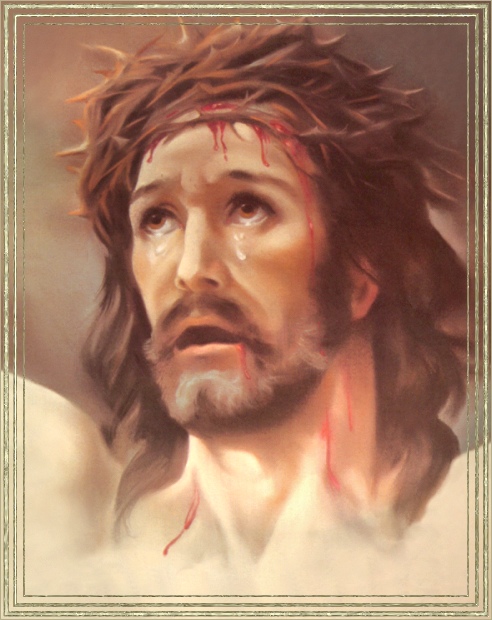
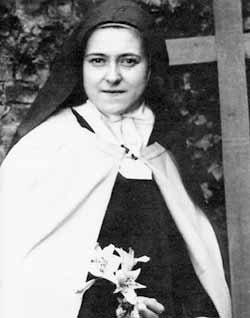
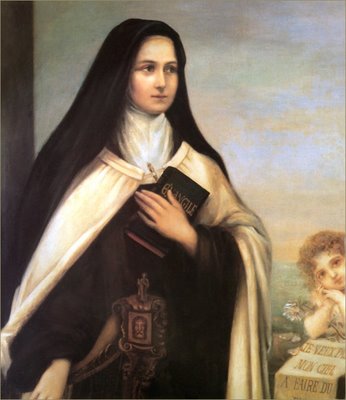
St. Thérèse of the Child Jesus and Holy Face

Today's the most beautiful Feast day of my dearest dearest patron, Saint Thérèse of the Child Jesus and Holy Face! :) Yesterday and today were beautiful days for me. :) There was time (yay!) to go for morning Mass (yay!) and everything was beautiful even amidst all the tests and work that has to be done. I wonder how it must be in heaven. I can't wait. Haha. Pray for me, my dear blog readers, patience really is a necessary virtue.

Now, I'd like to write a little more about St. Thérèse. Here's a link to all I have written about her on my blog. I am sure many of you know a lot about her, after all, she's really really famous =D, "the greatest saint of modern times!" as Pope Saint Pius X said, almost prophetically, way before even St. Thérèse became Saint Thérèse. :) (I mean way before St. Thérèse was canonized.) Thus, I will write more about her prayers and her writings that really characterize and "show-off" what a beautiful most pretty and dear dearest soul St. Thérèse is. Most dear to Jesus and Mary! :)

[All excerpts and phrases etc, taken from various sources, including, The Story of the Soul, St Thérèse of Lisieux By Those Who Knew Her, the 1962 Roman Catholic Daily Missal, Douay-Rheims Holy Bible etc. etc.]

Her ideal throughout her entire life was simple, direct and heroic: "I want to be a saint." and that was all. Her whole life centred on this one ideal. "I want to spend my heaven doing good on earth." Her beautiful autobiography, The Story of a Soul, changed my life in a way I didn't know possible. Deo gratias et Mariae.

As Saint Paul in his second epistle to Timothy wrote: "For God has not given us the spirit of fear, but of power and of love and of prudence." (2 Tim. 1:7) St. Thérèse brought this truth to light for us especially in this modern (or rather now, post modern) world in which we live in. Her holiness, a holiness founded on unshakeable confidence in God and absolute love for Him. Her doctrine of sanctity is enshrined for the ages in her own phrase, "the little way of spiritual childhood." This teaching was not original with St. Thérèse. It was Jesus Himself who taught it. Jesus Himself who urged His followers to become "as little children", as we read in today's Gospel. And today's Epistle is also very very beautiful. This epistle, taken from the old testament (the prophet Isaias) was something special to St, Thérèse during her short but extremely beautiful life. Here it is:

"Thus saith the Lord: Behold I will bring upon her as it were a river of peace, and as an overflowing torrent the glory of the Gentiles which you shall suck; you shall be carried at the breasts, and at the knees they shall caress you. As one whom his mother caresseth, so will I comfort you: and you shall be comforted in Jerusalem. You shall see and your heart shall rejoice, and your bones shall flourish like an herb, and the hand of the Lord shall be known to his servants." (Is.66:12-14)

And also, the Gradual of the Mass today is also very very beautiful:

"I confess to Thee, O Father, Lord of heaven and earth, because Thou hast hid these things from the wise and prudent and hast revealed them to little ones. My hope, O Lord, from my youth." (Mt. 11:25; Ps. 70:5)

What is love?

St. Thérèse explains in her own good way:

Here's an excerpt from a testimony by Sister Marie-Joseph of the Cross, O.S.B. who was the maid and governess under the service of M. Guerin, St Thérèse's uncle, before she joined the Benedictine nuns of the Blessed Sacrament at Bayeaux. She was the 8th witness and she testified this on 12-15 December 1910:

"Shortly after her first communion, when she was about twelve, she used to talk to me about God: how good he was to those who loved him, the love he bore each of us individually. As I did not feel all that much love for him, and said as much to her, she explained that love was not a matter of what you felt but of practising virtue, and that we should always try to please God in the least of our actions, without any attempt to draw attention to ourselves."


When the witness, Marcelline, before she became a nun, told St Thérèse that she intended to become a nun, St Thérèse told her this:

"we must always Love God a great deal, and to prove that love we must make all the sacrifices he asks of us. Don't worry, I'll be praying for you. Love God so that you won't be too afraid of him; he is so kind, really! Remember too to pray for those who do not love him, so that we can convert many souls."

As such, love of God equates love of sacrifice. The true definition of love is:

Love = Sacrifice

Love and Sacrifice are 2 things so interconnected, they cannot be separated. If you say you love someone, you say that you are willing to give your life for that someone. And, how beautiful that love is, so gentle, so warm, so tender, so infinite, that He would give up his life, hanging on something most disgusting, in order to bear the burden of our sins, our iniquities?

God chose St. Thérèse to dramatize this truth, to love and be like "little children", anew, reminding us always that great love, not great deeds, is the essence of sanctity.

What is perfection?

Perfection consists in doing His will, in being that which He wants us to be.

As St. Thérèse wrote in her autobiography.

"Jesus saw fit to enlighten me about this mystery. He set the book of nature before me and I saw that all the flowers He has created are lovely. The splendour of the rose and the whiteness of the lily do not rob the little violet of its scent nor the daisy of its simple charm. I realised that if every tiny flower wanted to be a rose, spring would lose its loveliness and there would be no wild flowers to make the meadows gay.

It is just the same in the world of souls - which is the garden of Jesus. He has created the great saints who are like the lilies and the roses, but He has also created much lesser saints and they must be content to be the daisies or the violets which rejoice His eyes whenever He glances down. Perfection consists in doing His will, in being that which He wants us to be.

I also understood that God's love shows itself just as well in the simplest soul which puts up no resistance to His grace as it does in the loftiest soul. Indeed, as it is love's nature to humble itself, if all souls were like those of the holy doctors who have illumined the Church with the light of their doctrine, it seems that God would not have stooped low enough by entering their hearts. But God has created the baby who knows nothing and can utter only feeble cries. He has created the poor savage with no guide but natural law, and it is to their hearts that He deigns to stoop. They are His wild flowers whose homeliness delights Him. By stooping down to them, He manifests His infinite grandeur. The sun shines equally both on cedars and on every tiny flower. In just the same way God looks after every soul as if it had no equal. All is planned for the good of every soul, exactly as the seasons are so arranged that the humblest daisy blossoms at the appointed time."

Beautiful. Dearest Jesus, help me only to do what Thou wilt want me to do. Thy Holy Will is most perfect.

Saint Thérèse's name in religion was Thérèse of the Child Jesus and Holy Face.

She composed a beautiful prayer in honour of His Most Holy Face:

"Jesus, Who in Thy bitter Passion didst become "the reproach of men and the Man of Sorrows", I venerate Thy Holy Face on which shone the beauty and gentleness of Divinity. In those disfigured features I recognize Thine infinite love, and I long to love Thee and to make Thee loved ...

May I behold Thy Glorious Face in Heaven!"

And here's a beautiful prayer I'd like to add here in this post to dearest St. Thérèse, my patron:

St. Thérèse, the little flower, please pick me a rose from the heavenly garden and send it to me with a message of love. Ask God to grant me the favour I thee implore and tell Him I will love Him each day more and more.

And here's an excerpt from Alone with God by Fr. Heyrmann S.J.:

October 3

St. Thérèse of the Child Jésus and Holy Face

1. In the Mass we read a passage of the Gospel hat is most appropriate to this Saint. It sounds as if Jesus was introducing “Little Thérèse” to the modern world: “Amen I say to you, unless you be converted and become as little children, you shall not enter into the kingdom of heaven” (Mt. 18:3). Thérèse of Lisieux never had any need of being converted: she was a child to the very marrow of the bones; never was she anything else; never did she wish to be anything else. She said, “Even if I were to live many more years, I would take care to remain a little child.”

2. Petition: The grace to grasp the Lord’s doctrine about becoming like little children: may we tread courageously the “Little Way” of St. Thérèse, which she paved and followed so heroically.

I. Little in Appearance

At first sight, and on a superficial estimate, St Thérèse does by no means appear a “grand Saint”. She made no foundations, worked no striking miracles, had no ecstasies, did nothing extraordinary, taught no wonderful doctrine. Her “teaching”, however original and personal it may have been, was exceedingly simple: “My little doctrine,” as she used to say. Nothing in her life, before or after her entrance into religion, could be described as extraordinary. When at the age of 24 she died, a fellow religious is recorded to have observed, “I wonder what one can say about her in her obituary notice.” Of that, God Himself had taken care. At the command of her Superior, she herself had written an account of her life. She did know that God had something to say to the world through her.

Yet, in her own eyes, she was and remained little. God was her Father and she was His child; and of this relation of child to Father she was fully convinced; this fact pervaded her whole life and her spirituality. Her style of writing and her figures of speech are childlike – perhaps they border on the childish; she is a ball with which Jesus plays as He pleases; if she meets an obstacle, she does not dash against it; being small, “she creeps beneath”.

“I am too little to be damned,” she once said humorously, yet very profoundly; her style bristles with diminutives.

If in all sincerity the great St. Paul could think and say that in him “God hath chosen the foolish things of the world, and the things that are contemptible, and the things that are not, that he might bring to nought things that are” (1 Cor. 1:27, 28), then we can readily understand what a poor opinion little Thérèse entertained of herself. But because of this poor opinion God chose to do great things through her.

II. Great in Truth

In this “little soul”, there is nothing that is petty, or childish. She loves to draw her figures of speech from the world of children, but in her spiritual life she is an adult, perfectly mature, and brave, who, like St. Paul, “had put away the things of a child”. Sensible devotion and consolation in prayer, anxiety to calculate what progress one is making or to gather merits she had gone beyond all these trappings of the spiritual life, that she might cling firmly to God’s holy will. “I have only one joy: to suffer for Jesus; and this joy, though not a matter of feeling, still surpasses every other joy … I have found the secret how to suffer in peace and joy: we need only will what God wills.” She was courageous: “True courage,” she wrote, “consists in this: to desire the cross, even with dread in your heart, and with internal repugnance, as Jesus in the garden.” Her “Little Way” of total surrender to God in self-forgetting love, comes indeed very close to the “yet a more excellent way”, of which St Paul wrote to the Corinthians (1 Cor. 12:31).

Her zeal for the Missions throughout the world, and the letters she wrote to missionaries, proved the largeness of her heart: from the narrow window of her cell her eyes surveyed the whole world. Pope Pius XI appointed her Patroness of the Missions, together with St. Francis Xavier, the great Apostle of modern times.

III. God’s Work in Her

Little Thérèse was aware that she was a privileged child of God, and that God wanted to give through her a message to the Church. “Mother,” she once said to her Prioress, “you thought you were not imprudent when you told me that God had enlightened my soul, and had given me the experience of mature years. I am too small to grow vain on that account; too small to look for appropriate words to express how humble I am; I prefer to say the simple truth: He that is mighty hath done great things to me.” Throughout life her love of truth and of absolute sincerity was very great. She abhorred whatever savoured of sham, or pretence, or insincerity. To the world, and more still to all who in religion strive after perfection, she has announced the glad tidings that the greatest perfection can be achieved in the humblest surroundings, and in the most complete separation from the world.

Prayer: O Lord, who hast said, Unless you become as little children you shall not enter into the Kingdom of heaven; we ask of Thee the grace so to follow, by humility and simplicity of heart, in the footsteps of the virgin Saint Thérèse, that we may win eternal rewards. Who livest and reignest world without end (Collect of the Mass of today).

(as with St. Thérèse:) O Mon Dieu, comment je T'aime!

Deus propitius esto mihi peccatori

Jesus, Mary, I love Thee; Save Souls!

Jesu mitis et humilis corde, Fac cor nostrum secundum Cor tuum. (ter)

Labels: ,

Sunday, November 12, 2006

From my favourite saint, my heavenly patron .. St. Thérèse!

I'd like to take some time off my work to write a little on my favourite heavenly patron, Dearest Saint Thérèse of Lisieux, whose name was Sister Thérèse of the Child Jesus and Holy Face.
I have a book on Saint Thérèse, providentially given to me by a very good priest,
it is titled St Thérèse of Lisieux By Those Who Knew Her edited and translated by Christopher O Mahony, its basically a compilation from testimonies submitted by various blessed people, who knew St Thérèse, taken from the process of her beatification. The whole book is a real treasure! especially on the Saint herself and insights on various aspects of her 24 year, most beautiful life on earth. =) Deo gratias et Mariae!

A question one can ask is: Why do I want to study a Saint's life so intimately?
The Answer that is given says this - and this is true wisdom: The Saints are definitely in heaven and they are there already because of their very saintly lives - they imitated Christ, and attained very high levels of perfection. Studying a Saint's life is like reading a score from which music is played and interpreted. The music here being how your life should be lived. A Saint's life is like a manuscript from which we can imitate and from which we can draw on the fruits of living a saintly life here on earth, so that we may, in our stead too, attain the very end that we were called to fufill, paradise for eternity, praising and loving God in saecula saeculorum.

Saint Thérèse in a popular representation.

Here's an excerpt from a testimony by Sister Marie-Joseph of the Cross, O.S.B. who was the maid and governess under the service of M. Guerin, St Thérèse's uncle, before she joined the Benedictine nuns of the Blessed Sacrament at Bayeaux. She was the 8th witness and she testified this on 12-15 December 1910.

"Shortly after her first communion, when she was about twelve, she used to talk to me about God: how good he was to those who loved him, the love he bore each of us individually. As I did not feel all that much love for him, and said as much to her, she explained that love was not a matter of what you felt but of practising virtue, and that we should always try to please God in the least of our actions, without any attempt to draw attention to ourselves."

When the witness, Marcelline, before she became a nun, told St Thérèse that she intended to become a nun, St Thérèse told her this:

"we must always Love God a great deal, and to prove that love we must make all the sacrifices he asks of us. Don't worry, I'll be praying for you. Love God so that you won't be too afraid of him; he is so kind, really! Remember too to pray for those who do not love him, so that we can convert many souls."

As such, love of God equates love of sacrifice. The true definition of love is:

Love = Sacrifice

Love and Sacrifice are 2 things so interconnected, they cannot be separated. If you say you love someone, you say that you are willing to give your life for that someone.

And, how beautiful that love is, so gentle, so warm, so tender, so infinite, that He would give up his life, hanging on something most disgusting, in order to bear the burden of our sins, our iniquities? And as I posted up a few months ago, in July,

-Whosoever on earth would endure all that, just to cleanse us of our iniquity?-

None other than the greatest love of All - Jesus.

I am now reminded of a paragraph I read some time ago in St Alphonsus Ligouri's book on The Passion and the Death of Jesus Christ.

(This is taken from Chapter 1: The Love of Jesus Christ in being willing to satisfy the Divine Justice for our sins.)

I.

We read in history of a proof of love so prodigious that it will be the admiration of all ages.

There was once a king, lord of many kingdoms, who had one only son, so beautiful, so holy, so amiable, that he was the delight of his father, who loved him as much as himself. This young prince had a great affection for one of his slaves; so much so that, the slave having committed a crime for which he had been condemned to death, the prince offered himself to die for the slave; the father, being jealous of justice, was satisfied to condemn his beloved son to death, in order that the slave might remain free from the punishment that he deserved: and thus the son died a malefactor's death, and the slave was freed from punishment.

This fact, the like of which has never happened in this world, and never will happen, is related in the Gospels, where we read that the Son of God, the Lord of the universe, seeing that man was condemned to eternal death in punishment of his sins, chose to take upon himself human flesh, and thus to pay by his death the penalty due to man: He was offered because it was His own will - Isa. liii. 7.

And his Eternal Father caused him to die upon the cross to save us miserable sinners: He spared not His own Son, but delivered Him up for us all. - Rom. viii.32 .

What dost thou think, O devout soul, of this love of the Son and of the Father?

Thou didst, then, O my beloved Redeemer, choose by Thy death to sacrifice Thyself in order to obtain the pardon of my sins. And what return of gratitude shall I then make to Thee? Thou hast done too much to oblige me to love Thee; I should indeed be most ungrateful to Thee if I did not love Thee with my whole heart. Thou hast given for me Thy divine life; I, miserable sinner that I am, give Thee my own life. Yes, I will at least spend that period of life that remains to me only in loving Thee, obeying Thee, and pleasing Thee.

-------

St Alphonsus Ligouri's writings are fabulous!! =) don't you agree? =)

and here's a link to one of the books I was blogging about in my previous post, its a really really really good book! =)

The Mystical City of God by Venerable Mary of Agreda

-------

Jesus, Mary, I love Thee, Save Souls!

Friday, August 25, 2006

St. Thérèse of the Child Jesus and the Holy Face

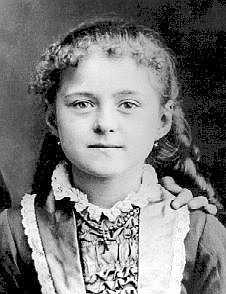
St, Thérèse at age 8

-

St, Thérèse of the Child Jesus and the Holy Face - The Little Flower

I'd like to take some time off my now busy schedule to post a little something about my favourite saint, my patron also, St. Thérèse of Lisieux.

Interestingly, Pope Saint Pius X, he himself a great saint, called her The greatest saint of modern times, way before she was even beatified. This young little carmelite, dearest St. Thérèse, only 24 years when she expired into the joys of eternal life, has much much much much to teach all of us about her "little way of spiritual childhood".

To find out more about her and her life, I recommend to you reading her Autobiography. It changed my life as I know it and I am very sure it will touch you most profoundly too. Her Story of a Soul is written in a language so very simple, it speaks of "profoundity", it speaks so deeply!
-------
Here are 2 of the great Saint Thérèse's - the LITTLE flower's poems, for you to contemplate, meditate upon.

Here she speaks on love, and how loving is to give oneself up to suffering, just like what Jesus did when he willingly embraced his cross for our sakes.

Here on earth, to live for love
does not mean settling on Thabor;
it means climbing Calvary with Jesus
and looking on the Cross as a treasure.

Another poem she wrote on faith, when she was experiencing temptations against her faith which were troubling her more than usual,

Since the Son of God wished his Mother
to undergo darkness and heartfelt anguish,
Mary, is it therefore a good thing to suffer here on earth?
Yes, to suffer out of love is purest happiness.
Jesus can take back everything he has given me,
But tell him never to get angry with me.
He can hide if he likes, and I will wait for him
Till that undying day when my faith will cease to be.

-------


In Christo et Maria!

rachel anne thérèse

Tuesday, October 03, 2006

Dearest Saint Thérèse of the Child Jesus and Holy Face

This is dear Saint Thérèse of Lisieux :) , my lovely heavenly patron.
(her name in religion was Sister Thérèse of the Child Jesus and the Holy Face)
and today is her feast day! :)

I wonder how it must be like in heaven today. ;)

-------

Here's a link to a post I blogged on dear St, Thérèse some time back. :)

-------

And here is the very beautiful proper of the mass of today.

INTROIT Cant. 4:8-9; Ps. 112:1

Come from Libanus, my spouse, come from Libanus, come; thou hast wounded my heart, my sister, my spouse, thou hast wounded my heart. (Psalm) Praise the Lord, ye children: praise ye the name of the Lord. Glory be to the Father and to the Son and to the Holy Ghost, as it was in the beginning, its now and ever shall be, world without end. Amen.

COLLECT

O Lord, Who hast said: Unless you become as little children you shall not enter into the Kingdom of heaven: grant unto us, we beseech Thee, so to follow in humility and simplicity of heart the footsteps of Saint Theresa, the Virgin, that we may obtain everlasting rewards: Who livest and reignest.

EPISTLE Is.66:12-14

The Church applies these words of the Prophet to St. Theresa

Thus saith the Lord: Behold I will bring upon her as it were a river of peace, and as an overflowing torrent the glory of the Gentiles which you shall suck; you shall be carried at the breasts, and at the knees they shall caress you. As one whom his mother caresseth, so will I comfort you: and you shall be comforted in Jerusalem. You shall see and your heart shall rejoice, and your bones shall flourish like an herb, and the hand of the Lord shall be known to his servants.

(This excerpt from the old testament was something special to St, Thérèse during her short but extremely beautiful life.)

GRADUAL Mt. 11:25; Ps. 70:5

I confess to Thee, O Father, Lord of heaven and earth, because Thou hast hid these things from the wise and prudent and hast revealed them to little ones. My hope, O Lord, from my youth.

ALLELUIA Ecclus. 39:17-19

Alleluia, alleluia. Bud forth as the rose planted by the brooks of waters: Give ye a sweet odor as frankincense. Send forth flowers as the lily, and yield a smell, and bring forth leaves in grace, and praise with canticles and bless the Lord in his works. Alleluia.

GOSPEL Mt. 18:1-4

At that time, the disciples came to Jesus, saying: Who, thinkest Thou, is the greater in the kingdom of heaven? and Jesus calling unto Him a little child, set him in the midst of them, and said: Amen I say to you, unless you be converted, and become as little children, you shall not enter into the kingdom of heaven. Whosoever therefore shall humble himself as this little child, he is the greater in the kingdom of heaven etc.

OFFERTORY Lk.1:46-48,49

My soul doth magnify the Lord: and my spirit hath rejoiced in God my Saviour: because He hath regarded the humility of His handmaid. He that is mighty hath done great things to me

(A little note: this is an excerpt from Mother Mary's beautiful Magnificat, Mother Mary's hymn of thanksgiving to God when she met St, Elizabeth after she found out the news from the archangel Gabriel -during the Annunciation- that St, Elizabeth was with a child, St, John the Baptist, the Precursor, Jesus's cousin.)

SECRET

May the holy prayers of Saint Theresa Thy Virgin, we beseech Thee, commend our sacrifice to Thee, O Lord: in her honor we solemnly offer it: in view then of her merits do Thou accept it. Through our Lord.

COMMUNION Deut. 32:10-12

He led her about and taught her, and He kept her as the apple of His eye. As an eagle He has spread His wings and hath taken her on His shoulder. The Lord alone was her leader.

POSTCOMMUNION

May the heavenly mystery, O Lord, inflame us with the fire of that love by which Saint Theresa, Thy Virgin, offered herself to Thee as a victim of charity for mankind. Through our Lord.

-------

Theresa is the english translation from the french, Thérèse. Dear Saint Thérèse was French.

She lived in the Normandy region of France, (Northern France) and entered the Carmel at Lisieux when she was only 15.

-------

One of Saint Thérèse's famous phrase that eloquently sums up her whole life is:

"I want to spend my heaven, doing good on earth."

-------

O yes, Happy Feast Day to all the Thérèse's! =p.

Happy feast day to my dearest sister, Denise Elizabeth Thérèse,

Happy feast day to my 'sister' also, Angeline Marie Thérèse!

Happy feast day to Noelle Theresa too!

Dearest Saint Thérèse of the Child Jesus, please pray for us!

O happy day!!!

-------

In Christo et Maria! =)

rachel anne thérèse

Monday, October 03, 2011

Happy Feast Day of St. Thérèse of the Child Jesus! =)))

Never be discouraged!

It's the most blessed and happy feast day of St. Thérèse of the Child Jesus (more affectionately known as: The Little Flower). She's my name saint! And so today, it's just like my birthday! :D when it is my patron saint's birthday in heaven! :D

I strongly recommend her autobiography, "The Story of a Soul".

In a tribute to my dearest patron saint who has taught me so much, so much and who has guided me so much, so much, here is a post, dedicated specially to her, written almost entirely in her own words:

When she was a child, when her mother asked her a question, "Where dwelleth God, think you?" She replied,

"O, everywhere in all the world,

Then in the heaven so blue."

When I first read her autobiography as a teenager growing up, this struck me:

I often asked myself why God had preferences, why all souls did not receive an equal measure of grace. I was filled with wonder when I saw extraordinary favours showered on great sinners like St. Paul, St. Augustine, St. Mary Magdalen, and many others, whom He forced, so to speak, to receive His grace. In reading the lives of the Saints I was surprised to see that there were certain privileged souls, whom Our Lord favoured from the cradle to the grave, allowing no obstacle in their path which might keep them from mounting towards Him, permitting no sin to soil the spotless brightness of their baptismal robe. And again it puzzled me why so many poor savages should die without having even heard the name of God.


Our Lord has deigned to explain this mystery to me. He showed me the book of nature, and I understood that every flower created by Him is beautiful, that the brilliance of the rose and the whiteness of the lily do not lessen the perfume of the violet or the sweet simplicity of the daisy. I understood that if all the lowly flowers wished to be roses, nature would lose its springtide beauty, and the fields would no longer be enamelled with lovely hues. And so it is in the world of souls, Our Lord's living garden. He has been pleased to create great Saints who may be compared to the lily and the rose, but He has also created lesser ones, who must be content to be daisies or simple violets flowering at His Feet, and whose mission it is to gladden His Divine Eyes when He deigns to look down on them. And the more gladly they do His Will the greater is their perfection.


I understood this also, that God's Love is made manifest as well in a simple soul which does not resist His grace as in one more highly endowed. In fact, the characteristic of love being self-abasement, if all souls resembled the holy Doctors who have illuminated the Church, it seems that God in coming to them would not stoop low enough. But He has created the little child, who knows nothing and can but utter feeble cries, and the poor savage who has only the natural law to guide him, and it is to their hearts that He deigns to stoop. These are the field flowers whose simplicity charms Him; and by His condescension to them Our Saviour shows His infinite greatness. As the sun shines both on the cedar and on the floweret, so the Divine Sun illumines every soul, great and small, and all correspond to His care—just as in nature the seasons are so disposed that on the appointed day the humblest daisy shall unfold its petals.


I finally understood a great many things. Of her simplicity in her approach to the spiritual life, of her great trust and love in our Lord Jesus and of course, of his dearest Mother, Our Mother Mary. And because of what she understood, she called herself, "The Little Flower", a nickname how apt and how not so apt! (oh the irony!) Her "Little Flower" way of Spiritual Childhood:

The Way of Spiritual Childhood stresses again that love & not great
outward achievement is the fulfilling of the law...Beneath St
Therese's childlike phrasing the saint has portrayed a life which calls
for an unflagging generousity & courage which, united with the
humility & confidence of a little child, is heroic indeed. Benedict XV
has called her way "the secret of sanctity."

To me, one of the most beautiful things she has said and written about is this:

"Our Lord does not come down from Heaven everyday to lie in a golden ciborium. He comes to find another heaven which is infinitely dearer to Him - the heaven of our souls, created in His Image, the living temples of the Adorable Trinity."

I juxtaposed this quote of hers to another I heard, on the 16th Sunday After Pentecost 2011 (also the feast day of The Holy Guardian Angels):

That there are 2 kinds of graces, (1) Sanctifying grace: grace that makes ordinary actions HOLY and (2) Actual Grace: grace that God gives to help us in all our needs.

(1) Sanctifying grace makes us saints, brings us closer to God. When you are in a state of grace (or sanctifying grace), all your ordinary actions become holy, you are in a state of habitual grace or permanent grace: and so it says in Holy Scripture, precious, very precious words of Jesus:

John 14: 23

Christ's discourse after the Last Supper:

[21] He that hath my commandments, and keepeth them; he it is that loveth me. And he that loveth me, shall be loved of my Father: and I will love him, and will manifest myself to him. [22] Judas saith to him, not the Iscariot: Lord, how is it, that thou wilt manifest thyself to us, and not to the world?[23] Jesus answered, and said to him: If any one love me, he will keep my word, and my Father will love him, and we will come to him, and will make our abode with him. [24] He that loveth me not, keepeth not my words. And the word which you have heard, is not mine; but the Father's who sent me. [25] These things have I spoken to you, abiding with you.

And who is this "we", that Jesus speaks about?

It is none other than the Most Blessed Trinity: God the Father, God the Son and God the Holy Ghost!

-------

I want to end off with this quote from a friend:

Admittedly, many a time, the limits of our fallen human nature have

caused me unfortunately to fall , time and time again. However, I

know that St Therese will patiently guide this little sister of hers

towards the rock of eternal life, to Jesus , through His Holy Mother

Mary. For my part, I will strive to imitate her as best as I can, in my

state of life.

And a prayer, a most beautiful prayer to St Therese, asking her help to implore our dearest Jesus to help us:

St Therese the Little Flower, please pick me a rose from the heavenly garden and send it to me with a message of love. Ask God to grant me the favour I thee implore and tell God that I will love Him, always, more and more.

Amen.

Labels: ,

Saturday, April 24, 2010

St. Thérèse, Ora pro nobis


St. Thérèse, the Little Flower,
Please pick me a rose from the heavenly garden and send it to me with a message of love. Ask God to grant me the favour I thee implore, and tell Him that I love Him more and more.
Amen.
Dankeschoen. :))
Rachel Anne-Thérèse
Jesus, Mary, Joseph, Anne, Therese, I love You; Save Souls!

Monday, August 14, 2006

Another Term ...

And so another term starts. Blog update in a few days.
In CHRISTO et MARIA!
=Rachel Anne Thérèse=
--------------

The Crucifixion

The Passion and The Death of Jesus Christ – page 263

IV. The Crucifixion

It was revealed to St. Bridget that when the Saviour saw himself laid upon the cross, he stretched out his right hand to the place where it was to be nailed. They then immediately nailed the other hand, and then his sacred feet; and Jesus Christ was left to die upon this bed of anguish. St. Augustine says that the punishment of the cross was a most bitter torment, because, upon the cross, death itself was prolonged, lest the pain should be speedily ended.

O God! What horror must then have smitten heaven, at the sight of the Son of the Eternal Father crucified between the two thieves! Such, in truth, was the prophecy of Isaias: He was reputed with the wicked. Therefore St. John Chrysostom, contemplating Jesus upon the cross, cried out, full of amazement and love, “I see him in the midst, in the holy Trinity; I see him in the midst, between Moses and Elias; I see him in the midst, between two thieves.” As though he had said, “I see my Saviour first in heaven between the Father and the Holy Ghost; I see him upon the Mount Tabor, between two saints, Moses and Elias; how, then, can I see him crucified upon Calvary between the two thieves?” How could this come to pass, but through the divine decree, that thus he might die, to satisfy by his death for the sins of men, and to save from death, as Isaias had foretold: He was reputed with the wicked, and He hath borne the sins of many.

The same prophet also asks, Who is this that cometh from Edom, with dyed garments from Bosra; this beautiful one in His robe, walking in the greatness of His strength?”
(Edom signifying a red colour, though somewhat dark, as is explained in Gen. XXV. 30); and he gives the answer, I that speak justice, and am a defender to save. The person who thus replies is, according to the interpreters, Jesus Christ, who says, I am the promised Messiah, who am come to save men, by triumphing over their enemies.

Then, further, he is again asked, Why is Thy apparel red, and Thy garments like theirs that tread in the winepress? And he answers, I have trodden the winepress alone, and of the Gentiles there is not a man with Me. Tertullian, St. Cyprian, and St. Augustine explain the winepress to mean the Passion of Jesus Christ, in which his garments – that is, his most holy flesh – was covered with blood and wounds, according to what St. John wrote: He was clothed with a garment sprinkled with blood; and His name is called the Word of God. St. Gregory, explaining the expression I have trodden the winepress alone, says, “He trod the winepress, and was himself trodden.” He trod it, because Jesus Christ, by his Passion, his body was bruised and broken, as the grapes are broken in the winepress, and, as Isaias expresses it in another text, The Lord was pleased to bruise Him in infirmity.

And now behold this Lord, who was fairest among men, appears on Calvary with his form so disfigured by torments, that it struck horror into all who saw it. Yet this deformity makes him seem more beautiful in the eyes of souls that love him, because these wounds, these marks of the scourging, this lacerated flesh, are all tokens and proofs of the love he bears them; upon which the poet Petrucci beautifully sings, “O Lord, if Thou sufferest scourgings for us, to the souls that are bound to Thee, the more deformed Thou art, the more fair dost Thou appear.”

St. Augustine adds, “He hung in deformity upon the cross, but his deformity is our beauty.” And truly so, because this deformity of Jesus crucified was the cause of the beauty of our souls, which, when they were deformed, were washed with his divine blood, and became fair and lovely, according to what St. John wrote, Who are these that are clothed in white garments? These are they who have come out of great tribulation, and have washed their garments, and made them white in the blood of the Lamb.
All the saints, as being children of Adam (with the exception of the Blessed Virgin), were at one time covered with a foul garment, and soiled with Adam’s sin and with their own; but being washed with the blood of the Lamb, they became white and agreeable in the sight of God.

Well, then, didst Thou say, O my Jesus, that, when Thou shouldst be lifted up upon the cross, Thou wouldst draw everything unto Thee; “and this he said, signifying by what death he should die.” Truly Thou hast left undone nothing to draw all hearts unto Thee. Many are the happy souls who, in seeing Thee crucified and dying for love of them, have abandoned everything – possessions, dignities, country, and kindred, even to the embracing of torments and death – in order to give themselves wholly to Thee. Unhappy they who resist Thy graces, which Thou hast gained for them with Thy great labours and sorrows. O my God, this will be their great torment in hell, to think that they have lost a God who, to draw them to love him, gave his life upon a cross, that of their own choice they have perished, and that there will be no remedy for their ruin through all eternity. O my Redeemer, I have already deserved to fall into this ruin, through the sins I have committed against Thee. Alas, how often have I resisted Thy grace, which sought to draw me unto Thee, and, in order to cleave to my own inclinations, have despised Thy love, and turned my back upon Thee! Oh that I had died before I had offended Thee! Oh that I had ever loved Thee! I thank Thee, O my love, that Thou hast borne with me with so much patience, and that, instead of abandoning me, as I deserved, Thou hast repeated Thy calls, and increased Thy lights and Thy loving impulses upon me. I will sing the mercies of God forever. Oh, cease not, my Saviour and my hope, to continue to draw me, and to multiply Thy graces upon me, that I may love Thee in heaven with more fervor, remembering the many mercies that Thou hast shown me, after all the offences that I have committed against Thee. I hope for all, through that precious blood which Thou hast shed for me, and that bitter death which Thou hast endured for me.

O holy Virgin Mary, protect me; pray to Jesus for me.

- By Saint Alphonsus Ligouri.

-------

You can click on this link if you want to read something that I posted on our group blog, on the Vigil of the Assumption. The poetry is especially beautiful.

-------

Veritas Liberavit vos! (Jn 8:32)

And you shall know the truth, and the TRUTH shall make you free.

Wednesday, October 15, 2014

St Teresa of Avila!

+ J.M.J.A.T

Happy feast day of St Teresa of Avila! The patron saint of dearest St Therese of the Child Jesus and Holy Face, therefore my patron too!!! : D 


I love St Teresa of Avila's poems! From the very little I know of her poems, they are extremely rich, even though I only know them from the English translation and not in their original Spanish. They tell us of her beautiful spirituality. 

Quoting from the Foreword taken from St Therese of Lisieux's Autobiography, Story of a Soul: 

“In fact this reading moves the hearts of men, inclines their wills, amends their lives, kindles charity and produces other salutary results which absolutely transcend human power, and can find no adequate explanation except in the action of Divine Grace itself.”3”

Excerpt From: Saint Therese of Lisieux. “The Story of a Soul.”

“3. The proclamation of the heroic Virtue of Sister Thérèse of the Child Jesus by the Congregation of Rites, 14th August, 1921.”

Deo gratias et Mariae et Teresa of Avila for the beautiful poems! 

Let me share with you a short but beautiful poem by St Teresa of Avila "On Those Words: "Dilectus Meus Mihi":


Myself surrendered and given, The exchange is this:My Beloved is for me, And  I am for my Beloved. 
When the Gentle hunterWounded and subdued me,In love's arms,My soul fallen;New life receiving,Thus did I exchangeMy Beloved is for me,And I am for my Beloved. 
The arrow he drewFull of love,My soul was onesWith her Creator. Other love I want not,Surrendered now to my God,That my Beloved is for me,And I am for my Beloved. 

- St Teresa of Avila, taken from "The Collected Works of St. Teresa of Avila, Volume Three"


Jesus, Mary, Joseph, Anne, Therese, I love You; Save Souls!

Deus propitius esto mihi peccatori.

Jesu mitis et humilis corde, Fac cor nostrum secundum Cor tuum. (ter)

Labels: , , , ,

Friday, April 27, 2007

St. Peter Canisius

A short break now, from the mountain of books (ah the horror, lol, not so terrible, not so terrible) :). O Beautiful Cross! Deo gratias et Mariae, One more major one to go, I am so glad biostats, cell bio and nutrition are over. My brain is utterly squeezed dry of its ability to retain any memory whatsoever though, haha, but, Deo volente, its alright! :)

I'll be typing a little - on St. Peter Canisius, Confessor, Doctor of the Church, whose blessed feast day this 27th of April is.

Peter Kanis (or Canisius), born at Nimeguen in Holland, after brilliant studies at Cologne and Louvain, entered the Company of Jesus, of which he is one of the chief glories. The wisdom of his controversy, his eloquent preaching, his instructive writings (for example, the first catechism) caused him to be called the Hammer of Protestantism. He died at Fribourg in Switzerland in 1597.
As taken from the 1962 Roman Catholic Daily Missal

And here's something really really beautiful that my patron saint, St. Thérèse of the Child Jesus and the Holy Face wrote in one of her poems:
Here on earth,
to live for love,
does not mean settling on Thabor;
it means climbing Calvary with Jesus
and looking on the Cross as a treasure.

How beautiful is that. :)

Saint Thérèse, Ora pro nobis!

Jesus, Mary, I Love Thee; Save Souls!

p/s: do you hear the beautiful gregorian chant when you get into this page? :) Deo gratias et Mariae, I found out how to put music on this blogpage. Now playing is the beautiful Regina Caeli, which is said during Paschal Time. Link to the full prayer is as above. :) God Bless.

Labels: ,

Wednesday, February 14, 2007

Ferial, comm of St Valentine, MARTYR

St. Francis of Assisi, the Seraphic Lover
A prayer for Students

St. Valentine:

This holy Roman priest assisted with other pious Christians a great number of martyrs. He was beheaded under Aurelian in 270 A.D.


(from the 1962 Roman Catholic Daily Missal)

Introit of Holy Mass today:


In virtute tua, Domine,

laetabitur justus:

et super salutare tuum exsultabit vehementer:

desiderium animae

ejus tribuisti ei.

Quoniam praevenisti eum in benedictionibus dulcedinis:

posuisti in capite ejus coronam de lapide pretioso.

Gloria Patri.

Psalm 20: 2-4


In Thy strength, O Lord, the just man shall joy:

and in Thy salvation he shall rejoice exceedingly:

Thou hast given him his heart's desire.

For Thou hast prevented him with blessings of sweetness:

Thou hast set on his head a crown of precious stones.

Gloria Patri.


From the Old Testament, a very beautiful verse:


Et ecce tempus tuum, tempus amantium ...

Et decora facta es vehementer nimis.

Ezechiel xvi 8.13


And behold Thy time was the time of lovers ...

And Thou wast made exceeding beautiful.


O Dearest Jesus, I love Thee, I love Thee, I love Thee!

O Blessed Lady, ora pro nobis!

O Dearest Angels and Saints in heaven, ora pro nobis!


From St. Thérèse of the Child Jesus and Holy Face, my patron:


My God, how I love Thee!

Mon Dieu, comment je T'aime !

Labels: , , ,

Tuesday, July 25, 2006

What a wonderful thing!

My my! I just read something that literally blew me off my seat. (I was in the bus when I read this .. (lol) .. as usual, the bus was jerky and me being the silly engrossed self er..let's put it this way, I was/am/(hope not to be) clumsy.) BUT thing is, after reading this little page from the small book that I was holding, my reaction was a little like .. WOW! you have got to read this.=)
---

This is taken from page 13 of St. Alphonsus Ligouri's book, Uniformity with God's Will, translated from the Italian of the Saint, by Thomas W. Tobin, C.S.S.R.

The devout Father John Tauler relates this personal experience: For years he had prayed God to send him someone who would teach him the real spiritual life. One day, at prayer, he heard a voice saying: "Go to such and such a church and you will have the answer to your prayers." He went and at the door of the church he found a beggar, barefooted and in rags. He greeted the mendicant saying:

"Good day, my friend."

"Thank you, sir, for your kind wishes, but I do not recall ever having had a 'bad' day."

"Then God has certainly given you a very happy life."

"That is very true, sir. I have never been unhappy. In saying this I am not making any rash statement either. This is the reason: When I have nothing to eat, I give thanks to God; when it rains or snows, I bless God's providence; when someone insults me, drives me away, or otherwise mistreats me, I give glory to God. I said I've never had an unhappy day, and it's the truth, because I am accustomed to will unreservedly what God wills. Whatever happens to me, sweet or bitter, I gladly receive from his hands as what is best for me. Hence my unvarying happiness."

"Where did you find God?"

"I found him where I left creatures."

"Who are you anyway?"

"I am a king."

"And where is your kingdom?"

"In my soul, where everything is in good order; where the passions obey reason, and reason obeys God."

"How have you come to such a state of perfection?"

"By silence. I practice silence towards men, while I cultivate the habit of speaking with God. Conversing with God is the way I found and maintain my peace of soul."

Union with God brought this poor beggar to the very heights of perfection. In his poverty he was richer than the mightiest monarch; in his sufferings, he was vastly happier than worldlings amid their worldly delights.

---

This IS the answer to true happiness!

A good priest told this to me once, (or to this extend the way I remember it) in order to hear/listen to God, and let God enter into your soul, you need to be rid of worldly affections, rid of things that will cause God to be separated from you .. (etc)

Reading that particular page from St. Alphonsus's book and remembering what the good priest told me, I was compelled to put this up.

---

Dearest God! my happiness consists in doing everything entirely according to your will!

Dearest Mother Mary, please do help me!

My Patrons: St, Anne and St, Thérèse please pray for me!

A note: tomorrow's the feast day of O the most glorious Saint Anne! =) the mother of the most Blessed Virgin Mary! yay!!

-------
On a side-note, I've just checked the IVLE site and have realised that they have pre-allocated LSM 2101 - Metabolism and Regulation and LSM 2102 - Molecular Biology! this is good! as it means that next sem, I am officially without any lab practicals! (but I'm now laughing at how I'm going to take sem2.. cos' there will be more labs in sem2) .. deo gratias anyway!! =)

There's also a flip side to this pre-allocation: (!!) I've realised that there's no KL, ZH or Anni with me! They have been pre-allocated the other 2 modules instead .. !! but it's alright =) Let God work his will.

Now, I don't want the hols to end.. haha!

(thing is, God won't grant me this..time has to move on!!)

and so be it! Amen! =)

-------

PAX

In Christo et Maria!

-------

Let us learn to be more like HER (Mother Mary) who gave herself, her whole will, and who united everything she did to the will of God! Ave Maria!

Friday, September 14, 2007

The Feast of the Exaltation of the Holy Cross

Here's the link to last year's post on the Feast of the Exaltation of the Holy Cross, it is again very amazing to me how time flies and how it just slips by you in a twinkling.


Time, we must grab it, use every moment of it intelligently, smartly. Time, once lost, is gone forever. But, there's one thing good about time, as the years go by, the months, the weeks, the days, the hours, the minutes and the seconds go by, by the time past, we are, seconds, minutes, hours, days, weeks, months and years ... closer and closer to Him, closer and closer to attaining that one, only most important aim/goal of this life - to go to Heaven, to be with Him who is the only Way, the Truth and the Life. To go to Heaven, to be with dearest Mother Mary and all the beautiful Angels and wonderful Saints. To love and to be loved in return, love for Love, life for Life, heart for Heart, (what the Heart of my Jesus and your Jesus too! has to offer to all souls). O how beautiful it is!

Time flies, the deathbed awaits,
The frail human heart falters and stumbles.

But the Cross, O how it heals!
The wounds of the frail human heart.
Now the heart, with each beat, the strength renews.
By the Cross, death is conquered.

Death, ah, death, the bane of mankind,
But Death, O what is death?

The Stain of Sin
- it is life's only true Death.

Please do forgive me, if I start to sound a little funny, writing about death and such. :) But, death, it is something very important. It is something that we all have to think about and face, whether now, tomorrow or when the day comes. For earthly life is but only a pilgrimage, and your deathbed is when the most important moment of your life comes.

As this prayer of St. Pius X to St. Joseph, puts it very very beautifully:

O glorious St. Joseph, model of all who are devoted to labour, obtain for me the grace: To work in a spirit of penance, for the expiation of my many sins; To work conscientiously, putting the call of duty above my inclinations; To work with gratitude and joy, considering it an honour to employ and develop by means of labour, the gifts received from God; To work with order, peace, moderation, and patience, never shrinking from weariness and trials; To work, above all, with purity of intention, and with detachment from self, having ever before my eyes the hour of death and the account I must give of time poorly spent, talents unused, good omitted, and vain complacency in success. All for Jesus, all through Mary; all after thy example, O Patriarch Joseph; such shall be my watchword in life and in death. Amen.

The Holy Eucharist, the Most Blessed Sacrament, is most beautifully explained by this song, O Esca Viatorum. The first few phrases when loosely translated to English from the Latin goes: O Food on our Journey, O Bread of the Angels, O Bread of Heaven! We have Him with us, right here, on earth, the King of kings! To help us along this journey, to aid us, as our human heart is frail and which cannot sustain us fully, as we tred the thorny paths of this earth, yearning for the one and only End - Heaven for all eternity. What a beautiful aspect and most sublime (to me :D) aspect of our Faith!

It was said by a servant of God, If anything could shake my faith in the Eucharist, it would not be the doubt as to how the bread could become flesh, or how Jesus could be in several places and confined into so small a space, because I should answer that God can do everything; but if I were asked how he could love men so much as to make himself their food, I have nothing else to answer but that this is a mystery of faith above my comprehension. O love of Jesus, do Thou make Thyself known to men and do Thou make Thyself loved!

"If Our Lord has shown us the example of suffering, then on the
contrary, we should almost have the desire to suffer with Him, the desire to
sacrifice ourselves with Him! And when the thorn of pain pierces us, we should
be happy, and find in this sacrifice our joy, our happiness, in associating
ourselves - as God wants us to associate ourselves - to the Passion of His Son
for the redemption of the world and for the redemption of our sins. Is this not
but another mark of love from God, His desire that we be united in suffering
with Our Lord Jesus Christ?

...

How beautiful it is, this Christian, this Catholic doctrine!
How completely it transforms our life! How completely it transforms our life
here below! And it is that which prepares us for life eternal "O crux, ave,
spes nostra!"
We refer to the Cross as our hope, for in fact, the Cross is
only a road, a way: the way to eternal life, to glory.
But it is necessary to
pass by way of the Cross! One must take up the Cross and bear it after Our Lord to arrive at eternal life. This via crucis should be ours throughout the course of our life so as to arrive at life eternal."

- Excerpts taken from a Sermon by Archbishop Lefebvre on the Feast of the Exaltation of the Holy Cross in 1975 at the Seminary in Ecône.

And here, is an excerpt from the Epistle of St. Paul to the Philippians, a beautiful piece of writing on his sentiments regarding death, how he longs to be with Jesus and yet at the same time, to stay on with the souls he so dearly loves, for the salvation of more souls for Jesus.

"For to me to live is Christ and to die is gain. But if to live
in the flesh is my lot, this means for me fruitful labour, and I do not know
which to choose. Indeed I am hard pressed from both sides - desiring to depart
and to be with Christ, a lot by far the better; yet to stay on in the flesh is
necessary for your sake. And with this conviction I know that I shall stay on
and continue with you all for your progress and joy in the faith, that your
rejoicing in my regard may abound in Christ Jesus through my coming to you
again.

...

Only let your lives be worthy of the gospel of Christ; so that,
whether I come and see you, or remain absent (St. Paul was hoping to be able
to visit them soon, this epistle was written from Rome in the year 63 A.D.)
, I may hear about you, that you are steadfast in one spirit, with one mind
striving together for the faith of the gospel. Do not be terrified in any way by
the adversaries; for this is to them a reason for destruction, but to you for
salvation, and that from God. For you have been given the favour on Christ's
behalf - not only to believe in him but also to suffer for him, while engaged in the same struggle in which you have seen me and now have heard of me."

-Phil. 1:21-30

And thus writes St. Paul, so beautifully... :)

O beautiful Cross of my Jesus!

-------

A picture speaks a thousand words. Along the same lines, many pictures will do the trick. Therefore, many pictures will speak many many a thousand words ... :) haha :D ...

Today's the Feast of the Exaltation of the Holy Cross, and here are some beautiful beyond beautiful pictures taken from this beautiful book, The Sign of the Cross by Msgr. Jean-Joseph Gaume, published by the Desert Will Flower Press, the Traditional, Trans-Alpine Redemptorists.

And the Cross is never complete, without remembering the other person who suffered just as much for our Salvation ... Her whose Blessed Feast of the Seven Dolors is tomorrow, Dearest Mother Mary:


St. Thérèse of the Child Jesus and Holy Face, my dearest patron saint, a Carmelite, must have ate like this too? on Good Friday, in the Carmel at Lisieux ... :) very beautiful.


Read the caption that accompanies the picture, so wonderfully written I think:

To Create is to love; to conserve is to love; to Redeem is to love; to Sanctify is to love; to Glorify is to love. All Charity comes from the heart. God is, then, a heart. Do you know a Name more delightful? And this Name the Sign of the Cross repeats to us every time we make it.


And here's something to read on Quo vadis...


ECCE CRUCEM DOMINE
FUGITE, PARTES ADVERSAE,
VICIT LEO DE TRIBU JUDA,
RADIX DAVID, ALLELUIA.

-St. Anthony's Brief

Deus propitius esto mihi peccatori

Jesus, Mary, I love Thee; Save Souls!

Jesu mitis et humilis corde, Fac cor nostrum secundum Cor tuum. (ter)


Labels: , ,