Tuesday, August 14, 2012

The Vertebrate Animal Heart: Unevolvable, whether Primitive or Complex

My dear readers,


I'm in the process of helping my students learn about the Cardiovascular System, and I am at the part where I am trying to get them to ask questions about the heart. =D

I chanced upon this while sifting through piles of information, trying to make my lesson more interesting =)) I thought it appropriate as part of my *long,-really-long-ago* Evolution OUT! posts...

Taken from: 

The IDEA Center

I will reproduce this article here (for your perusal, some parts are really quite scientific, but it makes for good reading). Having said as much, please visit the original website. They have a link on articles relating to other unevolvable biological features! Plus, you will then be able to download this article as a .pdf then! =))

A Hearty Introduction:

Before we get going, here are some exciting heart facts to start your day with: In case your momma never told you, hearts have 2 types of chambers: atria and ventricles. Atria are where blood enters the heart and ventricles pump the blood out of the heart. Hearts take in oxygen poor blood, pump it through the pulmonary circuit (lungs/gills) where it gets oxygenated, and then they pump it out to the rest of the body. There are many many small veins (take blood to the heart) and arteries (carry it away) which connect the heart to the pulmonary circuit and keep it all running right. Blood pressure has to be carefully balanced in all tubes so that flow pressure is maintained and blood keeps moving, but not so fast as to explode certain areas or capillaries. One might say this careful and complex hydrostatic wiring might be easily selectable in an evolutionary scenario, but there's no getting around the fact that there's a very complicated and highly balanced network of biological fluid mechanics going on inside a heart than most artificial heart engineers probably care to think about.

Given all this, there are 3 basic ways to make a heart found in animals: a 2 chambered heart, a 3 chambered heart, and a 4 chambered heart. Fish have 2 chambers, one atrium and one ventricle. Amphibians and reptiles have 3 chambers: 2 atria and a ventricle. Crocodiles are the one reptilian exception, as they have 4 chambers (2 atria, 2 ventricles). Birds and mammals have 4 chambers (2 atria and 2 ventricles).

Differences between the hearts:

The fish heart (figure 1a) is much different than the amphibian/reptile/bird/mammal heart (figures 1b and c). Hearts are very complex--they're not just a bunch of random arteries and veins connecting tissue. Fish hearts simply draw in deoxygenated blood in a single atrium, and pump it out through a ventricle. This system is termed "single circulation", as blood enters the heart, gets pumped through the gills and out to the body, Blood pressure is low for oxygenated blood leaving the gills.

3 and 4 chambered hearts have a pulmonary circuit (pathways taking blood from heart to lung and back to heart) that is very complex and must be set up such that blood can travel from the heart to become oxygenated in the lungs and then be properly pumped back the heart and out to the body. The 3 (and 4) chambered heart has "double circulation" (figure 1b and c) and is quite different from "single circulation" (figure 1a) of fishes.

"Double circulation" has an interior circuit within the heart--blood enters the heart, leaves the heart and gets oxygenated, enters the heart again, and then gets pumped out to the body. Because "Double circulation" allows oxygenated blood to be pumped back into the heart before going out to the body, it pumps blood with much more pressure and much more vigorously than "single circulation".

Figure 1:
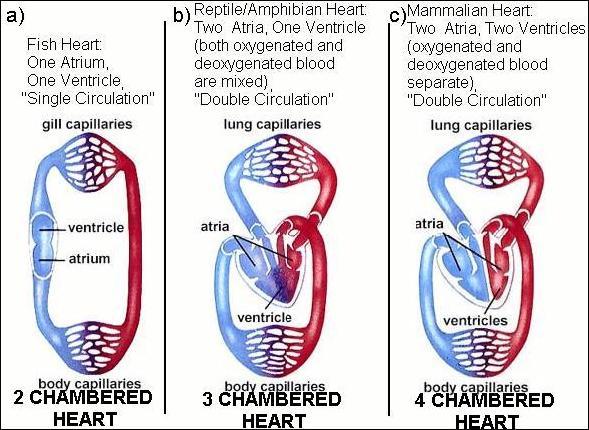
The Above diagram adapted from "http://gened.emc.maricopa.edu/bio/bio181/BIOBK/BioBookcircSYS.html#Vertebrate Vascular Systems which was said to be adapted from http://www.biosci.uga.edu/almanac/bio_104/notes/may_7.html and bears a striking resemblance to the diagrams from Campbell's "Biology" 4th edition pg. 822.

Though the 4 chambered heart has 2 atrium-ventricle pairs, both pairs do not do the same thing. There are 4 steps involved with blood entering the heart: 1) oxygen poor blood enters the first atrium. 2) oxygen poor blood is fed to the first ventricle, which pumps it out to the pulmonary circuit (lungs) where it is enriched in oxygen. 3) Oxygen rich blood just leaving the lungs is pumped back into the second atria. 4) Oxygen rich blood is then fed to the second ventricle, which pumps the oxygen rich blood out of the heart and back into the body for usage.

The 4 chambered heart differs from the 3 chambered heart in that it keeps oxygenated blood completely separate from de-oxygnated blood, because there is one ventricle for deoxgynated blood and one for oxygenated blood. In the 3 chambered heart, a single ventricle pumps both out of the heart, and there is some mixing between fresh and old blood. The 2 ventricle-4 chamber heart prevents mixing allows the blood leaving the heart to have far more oxygen than it would otherwise. This is good for enhancing the more fast paced lifestyle that birds and mammals tend to have, giving an advantage to having a 4 chambered heart.

Problems with evolving the hearts:

Getting a heart, period: Evolving a 2 chambered heart in the first place is very difficult because the circulatory system is irreducibly complex. At least 3 subsystems are necessary: 1) an organ for enriching the hemophlegm (blood) with oxygen (lungs/gills), 2) a complex network of closed tubes to carry the energy-rich blood to the body (veins and arteries), and 3) a pumping mechanism (heart) to transport energy-rich fluid throughout the body. One common way an evolutionist might try to get around problems associated with irreducible complexity might be to imagine scenarios where some or all of the subsystems could originate in a freestanding manner, functional on their own. However in this case what good is a closed tube network without a pumping mechanism to transport fluid, and what good is a pump without the fluid or the tubing? Oxygen exchange occurs in many organisms through the skin without a chordate-like circulatory system, but what is the advantage for such an organism to randomly mutate itself a single oxygen exchange organ (the lungs/gills)? Even so, once a single oxygen exchange organ was in place, it would need the very transport network provided by the heart, veins and arteries. Scenarios attempting the circulatory system in a step by step manner would fail and not take into account the overall complexity of the system.

Even if the subsystems of the circulatory system could be evolved on their own, evolving a freestanding 2 chambered heart on its own would be very difficult, even if it didn't need other components of the circulatory system to be useful. A human heart is an 11 ounce pumping machine the size of a human fist which beats over 2 billion times and pumps over 100 million gallons of blood over the course of the average human lifetime. It is primarily a shell with a carefully balanced interior network of holes and valves which keep fluid constantly flowing in, out, and in the right direction everywhere in between. A large number of fluid-directing parts as well as a very strong and properly and complexly shaped pumping muscle are necessary for it to function. The positioning of the parts of a heart are a good example of specified complexity. For this reason, the heart, as well as the entire circulatory system, are unevolvable in a step by step manner.

Getting a 3 chambered heart from a 2 chambered heart: Given a 2 chambered heart, experts do not know when, how, or in what lineage the alleged transition from the 2 chamber fish heart to the 3 chambered amphibian heart took place, mainly because this is a very difficult transition to even imagine. A 3 chambered heart has "double circulation" and is irreducibly complex with respect to "double circulation". 2 chambered hearts of fish have "single circulation" and the basic design is very different from a 3 chambered heart.

A vastly oversimplified explanation of the evolution of the heart might be to say that by simply duplicating the some or all of the chambers of a 2 chambered heart, one could easily evolve a functional 3 or 4 chambered heart. Of course the way the evolutionary story goes, fish turned into amphibians which turned into reptiles which became mammals and birds, so the heart is said to have evolved from 2 --> 3 --> 4 chambers. A direct 2 --> 4 chamber transition is never thought to have taken place and would have even more difficulties than a 2 --> 3 chamber transition, so we will focus on the 2 --> 3 chamber transition. However, in reality the changes that would need to take place for this transition are far more than merely the duplication of one or more chambers. It could not happen in a step-by-step manner where intermediates are functional.

The 2 chamber heart --> 3 chamber heart transition requires much more than the duplication of an atrium, because the interior circuit causing the "double circulation" of the 3 chambered heart must also be created. Duplicating the atrium without a closed circulatory network for "double circulation" would cause the heart to suck nothing but interstitial fluid out of the body. "Double circulation" only works when there is a loop feeding from a ventricle back to the heart, and back to a ventricle. Thus, both the loop and the new atrium are necessary for a 3 chambered heart to function. And though the loop (interior circuit) sounds simple, it really must be a complex tube network with valves in the right places to keep fluid flowing properly.

Single circulation hearts pump blood directly through the gas exchange organ and out to the body (figure 1a). Double circulation pumps blood to the lung/gills through an "interior circuit" loop and then back to the heart before going out to the body (figure 1b and c). And if this new loop doesn't connect with the gas exchange organ, then the new loop is functionless and useless. The easiest way to make this transition happen is probably to have the vein leaving the gas exchange organ feedback to become an artery feeding back into the heart. Of course this means the new vein-artery simultaneously needs the proper valves so it can function like an actual part of the heart itself. Probably of most importance is the fact that there is now no vein leaving the heart and pumping blood back out to the body. In other words, to create this interior circuit of double circulation, a new vein must be created and blood flow out of the heart completely rewired to the rest of the body.

Even if gas exchange organ could be bypassed (making it a less complex, though functionless and not selectively advantageous circuit), the main problem with going from single circulation to double circulation is that somehow this new circuit has to wire itself to the lungs. Either way, the vein leaving the heart must somehow also become an artery fed back into the heart through a new functional atrium and then a new vein must be created so that blood leaving the heart still gets out to the rest of the body through the circulatory network.

Finally, the heart muscle has to adapt to all of these changes, especially such that beating can occur to pump through the new atrium and associated fluid pressure changes.

In other words 4 primary changes are needed to go from single to double circulation:


  • The duplication of the atrium such that fluid transport through new atrium is functional
  • A conversion of the vein leaving the heart into an artery at the other end such that it is fed back into the heart.
  • A complete rewiring of how blood finally leaves the heart and goes out to the rest of the body (the creation of a new vein and rewiring).
  • Modification of the heart muscle to beat properly and accommodate the additional atrium and fluid pressure changes associated with the rewiring.

    If any of these steps are missing, double circulation won't work. And this says nothing about the many valves and other smaller veins and arteries associated with double circulation which characterize true hearts as well changes needed in the pumping mechanism of the heart muscle to accommodate a completely new atrium and fluid-pressure balance.

    The transition from 2 to 3 chambers requires a change from single to double circulation which involves at least 4 major simultaneous changes including the complete rewiring of how blood leaves the heart to the rest of the body. Many more minor simultaneous changes associated with mechanics of proper fluid transport would also be necessary. It not possible for double circulation system to evolve from a single circulation heart system in a Darwinian step-by-step manner because too many changes are necessary, making the 3 chambered heart unevolvable from a 2 chambered heart.

    Getting a 4 chambered heart: With respect to hearts with "double circulation", the 4 chamber mammalian heart probably isn't irreducibly complex. Going from 3 to 4 chambers really doesn't look all that complicated (of course they're still very different and this is totally oversimplified, but I'm only talking about basic organ design). Basically, the single ventricle in the 3-chambered heart is split into 2 chambers in the 4 chambered heart, making 2 ventricles instead of one. A "double circulation" heart could work with 3 chambers--and it does in reptiles and amphibians.

    The human heart has 2 atrium-ventricle pairs, which beat in succession something like pistons in a car. Only one ventricle is really needed to pump the blood. But just like an 8 cylinder engine put out a lot more horsepower than a 4 cylinder, so does a 4 chamber (2 pairs) heart have a much more power to supply the body with energy and oxygen-rich blood than a 3 chamber (1 ventricle) heart. There is a huge advantage to having a 4 chamber heart. Taking away the additional capillary complexities associated with suddenly having a second ventricle, one might be able to argue that the 3 to 4 chambered heart transition isn't difficult to imagine, relatively speaking, as all one has to do is note the strong advantage of separating oxygenated and de-oxygenated blood and then divide the ventricle in half. Of course the key word here is "imagine".

    Irreducible complexity is a real phenomena, and it can be analyzed, and so in some cases it might not exist, and in the case of the 4-chambered heart case it probably doesn't. Though the 4 chambered heart may not be irreducibly complex with respect to "double circulation", it might still be the result of intelligent design and not evolution, and irreducible complexity doesn't have to exist in all instances for it to exist in some. Overall, regardless of chambers, the heart has had much design put into it. And the complex double-circulatory heart bears strong marks of intelligent design.

    Getting a bird heart: Finally, the evolutionary origin of the bird heart-lung system is puzzling for the dino-bird hypothesis because "no lung in any other vertebrate species is known which in any way approaches the avian system." (Denton (1998), pg 361). Molecular biologist Michael Denton had the following to say about the evolutionary origin of the bird-heart-lung system:Just how such a different respiratory system could have evolved gradually from the standard vertebrate design without some sort of direction is, again, very difficult to envisage, especially bearing in mind that the maintenance of respiratory function is absolutely vital to the life of the organism. Moreover, the unique function and form of the avian lung necessitates a number of additional unique adaptations during avian development. As H. R. Dunker, one of the world’s authorities in this field, explains, because first, the avian lung is fixed rigidly to the body wall and cannot therefore expand in volume and, second, because the small diameter of the lung capillaries and the resulting high surface tension of any liquid within them, the avian lung cannot be inflated out of a collapsed state as happens in all other vertebrates after birth. In birds, aeration of the lung must occur gradually and starts three to four days before hatching with a filling of the main bronchi, air sacs, and parabronchi with air. Only after the main air ducts are already filled with air does the final development of the lung, and particularly the growth of the air capillary network, take place. The air capillaries are never collapsed as are the alveoli of other vertebrate species; rather, as they grow into the lung tissue, the parabronchi are from the beginning open tubes filled with either air or fluid (Denton (1998), 361)Denton goes on to say that, "The avian lung brings us very close to answering Darwin’s challenge: ‘If it could be demonstrated that any complex organ existed, which could not possibly have been formed by numerous, successive, slight modifications, my theory would absolutely break down.’

    One respiratory physiology expert, John Ruben, critiquing this evolutionary scenario noted that, "a transition from a crocodilian to a bird lung would be impossible, because the transitional animal would have a life-threatening hernia or hole in its diaphragm ... It seems clear that a bird’s radically different system of breathing, in which air is continuously drawn through its lungs, could not have evolved from the hepatic-piston system we see in this theropod dinosaur." (Gibbons, 1997 B, pg. 1230)

    Plus, we're also dealing with convergent evolution here. The 4 chamber system had to have evolved twice (and also in crocodiles), if it evolved at all, because mammals and birds are allegedly from very different reptilian stock. It isn't just a neat case of common ancestry being clear cut by characteristics.

    There are many other animals with hearts--some worms have like 5 or 6 hearts. These heats all probably evolved independently however. So, there is not a nice neat Darwinian tree with respect to hearts. Common design better explains this, because odds are low you would come up with a similar structure through chance evolution alone.

    Summary and conclusion:

    Fish: 2 chambers, Amphibians and reptiles: 3 chambers, Mammals and birds: 4 chambers. 3 and 4 chambered hearts are similar because they both have an interior circuit or "double circulation". This is very different from the 2 chambered heart which has "single circulation". Going from a 2 to a 3 chambered heart requires A LOT more than the mere duplication of a chamber, but a COMPLETE reworking of the veins and arteries surrounding the heart, interior valves of the heart, and the creation of this interior circuit which can properly interact with the lungs. Plus I have it on good authority that evolutionists don't know how the 2 to 3 chamber transition took place. Going from 3 to 4 might be more possible in a remote theoretical sense, though there are surely many less important complications. Going from 2 to 4 requires a vast more change than mere duplication of atria and ventricles. It might be remotely possible to go from a 3 chambered heart to a 4 chambered heart but it is not likely that a 2 chambered heart could evolve into a 3 or 4 chambered heart.
  • Deus propitius esto mihi peccatori

    Jesus, Mary, Joseph, Anne, Therese, I love You; Save Souls!

    Jesu mitis et humilis corde, Fac cor nostrum secundum Cor tuum. (ter)


    Labels: , , ,

    Tuesday, June 05, 2007

    Evolution OUT! - Part II: A Historical Perspective

    Tomorrow's the Feast of St. Norbert, Bishop and Confessor, Founder of the Premonstratensian Canons, more on the Premonstratensians Canons here.

    + J.M.J.A.T.
    Ad Majorem Dei Gloriam

    Evolution Out! Part I: Introduction

    Please read the introduction for the official disclaimer and also for an overall introduction to this series of posts. :)

    Evolution Out! Part II: A Historical Perspective

    Here's Part II of a small series of blogposts that I started sometime before the previous school term started. Now, with a little bit of extra time in my hands, I've decided to post Part II. The past semester was filled with only science modules - something that terrified (lol, it really did, especially biostats) me at the beginning of the semester, but after coming out of it unscathed and somewhat "rejuvenated", (Deo volente! and Deo gratias et Mariae!), I'm now ready to write this, with all that I thought about this topic and with little anecdotes (here and there) that come from the little and insignificant experiences of a life science major. [please refer to point no. 3 in the "reasons" section in Part I]

    As an introductory topic for Part II (today's post will focus on this. this post will continue on for the next few days if time permits), I'd like to offer you a historical perspective of this great evolution debacle by putting up a chapter from The Evolution Hoax Exposed; Former Title: Why Colleges Breed Communists by A.N. Field, published by TAN Books and Publishers, Inc. Rockford, Illinois 61105, which, in my opinion, gives a very interesting and very thoughtful historical perspective and insight on this topic. [I checked the book - there's no copyright infringement in any way.]

    Here's the excerpt:

    The Evolution Hoax Exposed (Former Title: Why Colleges Breed Communists)

    A.N. Field

    Chapter II: The Skeleton in the Cupboard
    [Transformist ideas ancient – French Revolution and evolution – Darwin’s theory – Glosses over lack of proof – Huxley more candid – Darwin’s private admission – Later admissions – All evolution theories collapse – No new species producible – Breeding experiments fail]

    With oaks to be seen sprouting from acorns, grubs turning into butterflies, and chickens pecking their way out of eggs, it is not surprising that human fancy from an early date toyed with the notion of one kind of living thing being transformed into some other kind. This idea has been the stock-in-trade of folk-lore and fairy tales in all ages and all lands. It was the achievement (!) of Charles Darwin to make it the foundation of modern biological science.

    At the end of the eighteen century there occurred that great event known as the French Revolution, described in various quarters as a landmark in the liberation of the human spirit (!). Incidentally, the student may learn from Alison’s History of Europe how in the course of this episode the mob in the streets of Paris roasted and ate the bodies of the massacred Swiss Guard of the royal palace on August 10, 1792, and how fifteen months later the multitude assembled in the Cathedral of Notre Dame (of all places!!!) to worship the “Goddess of Reason”, personified by an actress, also well known to the public in another capacity, placed naked (!in church!) by Government decree upon the altar of the French Westminister Abbey (!). State and people having alike discarded Christianity as outworn superstition, attention was directed in scientific circles to discovering how the world had come into being without intervention of the Almighty.

    Modern evolutionist theory dates from the writings of two French scientists of this period, the Comte de Buffon and M. Lamarck, the latter of whom propounded a theory of evolution by inheritance or acquired characters. Evolutionist ideas were also advanced in England by a medical man and author of Derby, Dr. Erasmus Darwin, correspondent and admirer of Jean Jacques Rousseau, chief philosopher of the French revolutionary era. Ideas of evolution began to float about, and in 1813, Dr. W.C. Wells aired the subject before the Royal Society in London.

    Scientists in the first half of the nineteen century were by no means all believers in Evolution. The Creationists were in a great majority, and the Evolutionists lacked a plausible theory of how evolution had occurred. This was all altered on the appearance of Charles Darwin’s Origin of Species in 1859.

    Darwin’s theory was that all species had evolved from primal protoplasm by Natural Selection, or survival of the fittest in the struggle for existence. As lambs still continued to appear with tails, despite the fact that their parents had had theirs cut off for generations back, Lamarck’s idea of evolution by inheritance of acquired characters had failed to convince. Darwin not only provided a more attractive theory but he elaborated it in a big book. He directed attention to the way breeders of domestic animals and plants got new varieties by selective breeding. He quoted instances of small variations occurring in all directions in living things. He argued that the rate of multiplication of living things produced an intense struggle for existence exterminating those with unfavourable variations and permitting those with favourable variations to flourish and increase.

    The idea of evolution as thus propounded met with immediate and astounding success. Not all scientists accepted it by any means, but it caught on and disbelievers were soon shouted down. In his presidential address to the British Association for the Advancement of Science in 1937 Sir Edward Poulton said the records showed that Dr. Wright back in 1881 was the last person to express disbelief in evolution at this British scientists’ parliament. The article on evolution in the current (1929) edition of the Encyclopedia Britannica affirms evolution to be an established fact supported by “overwhelming” evidence. In current newspaper and magazine literature evolution is similarly treated as a fact beyond dispute and in colleges and schools is usually rammed down the pupils’ throats as incontrovertible truth.

    Nevertheless, there is a small, slight hiatus in the argument. There is, unfortunately for evolutionists, not a shred of evidence of any living thing every evolving into some different kind of living thing capable of breeding but infertile with parent stock. All that breeding experiments have produced is mere varieties fertile with their parent stock, or else sterile hybrids, incapable of breeding, such as the mule produced by a cross between horse and donkey. All living things go on obstinately producing young after their own kind and no other kind. Evolution has to show that living things can break through their natural breeding limits. And this is just what evolution has been quite unable to show.

    This small defect in an otherwise pleasing theory Darwin glossed over in his books. Nevertheless, Darwin admitted in the introduction to his Origin of Species that evolution as a scientific theory “would be unsatisfactory, until it could be shown how the innumerable species inhabiting this world have been modified.” Before he got to the end of his 700 pages Darwin ignored this requirement, for, without meeting it, he declared himself in his concluding chapter “thoroughly convinced” of evolution.

    Huxley, who from the outset constituted himself the chief propagandist of Darwinism, was more logical. He made no bones about the total absence of any actual proof of evolution. In fact, he greatly annoyed Darwin by harping on the point, as anyone who cares to peruse the five volumes of Darwin’s letters and the two volumes of Huxley’s may discover for himself. “My God,” (!) wrote Darwin to Huxley in 1862, “is not the case difficult enough without its being, as I must think, falsely made more difficult. I believe it is all my own fault – my own d—d candour …” (More Letters of Charles Darwin, I, 230).

    This outburst was in consequence of Huxley having pointed out in his lectures and books that so far it had not been possible by selective breeding to produce a form capable of breeding but infertile with the parent stock. Huxley, in admitting this lack of evidence, said in his Edinburgh lectures in 1861 that if it could be shown that such failure was “the necessary and inevitable result of all experiments” he would hold Mr. Darwin’s hypothesis to be “utterly shattered.” (Man’s Place in Nature, Everyman edition, p.256). He added, however, that he looked for early proof to be forthcoming. In a letter to Darwin, Huxley said he told his students that he was satisfied that twenty years’ scientific breeding experiments with pigeons would provide the necessary proof (Huxley’s Life and Letters, I, 195-6).

    Although so heatedly rebuking Huxley in 1862, Darwin himself eight months later, privately admitted in a letter to Dr. Bentham the total absence of any proof of evolution. This is what he wrote under date of May 22, 1863: “In fact belief in Natural Selection must at present be grounded entirely on general considerations … When we descend to details, we can prove that no one species has changed (i.e., we cannot prove that a single species has changed); nor can we prove that the supposed changes are beneficial, which is the groundwork of the theory. Nor can we explain why some species have changed and others have not” (Darwin’s Life and Letters, iii, 25).

    Darwin died in 1882. Huxley died in 1895. Four years before he died Huxley wrote to Professor Romanes that evolution still stood without the evidence on which he had insisted thirty years before. He had always insisted, he said, on “the logical incompleteness of the theory so long as it was not backed by experimental proof” (Huxley’s Life and Letters, ii, 291).

    We now pass onwards another thirty years; and we find the noted English evolutionist, Professor Sir William Bateson, acknowledging exactly the same total absence of any proof of evolution. This is what he said to the congress of the American Association for the Advancement of Science in Toronto in 1921: -

    “When students of other sciences ask us what is now currently believed about the origin of species we have no clear answer to give … The conclusion in which we were brought up, that species are a product of summation of variations, ignored the chief attribute of species that the product of their crosses is frequently sterile in great or less degree. Huxley very early in the debate pointed out this grave defect in the evidence, but before breeding researches had been made on a large scale no one felt the objection to be serious. Extended work might be trusted to supply the deficiency. It has not done so, and the significance of the negative evidence can no longer be denied” (Nature, Ap. 29, 1922).

    Six years later another prominent evolutionist, Professor J.B.S. Haldane, in his book Possible Worlds (p. 38) said in 1927: “The barrier of inter-specific sterility is the most serious argument against Darwin’s Organic Evolution.” It is equally a barrier against any other kind of organic evolution.

    In 1931 we find the great Professor H.F. Osborn, of the United States, described by Britain’s Royal Society as the greatest palaeontologist of the day, making the following remarkable statement to a congress of the British Association: -

    “We are more at a loss than ever to understand the causes of evolution. One after another the Buffonian, Lamarckian, Darwinian, Weissmannian, and De Vriesan theories of causation have collapsed … All that we can say at present is that Nature does not waste time or effort with chance or fortuity or experiment, but that she proceeds directly and creatively to her marvelous adaptive ends of biomechanism” (Nature, September 28, 1931).

    This is an admission by one of the high priests of science that all theories of evolution have collapsed. Buffon propounded a general theory of evolution; Lamarck, tutor to Buffon’s children, followed with an idea of evolution by inheritance of acquired characters; Darwin advanced the idea of gradual small changes by natural selection; Weissman put all the emphasis on the germ plasm; and De Vries put forward the idea of evolution by mutations or sudden large variations.

    Two years later on again Professor James Ritchie, the great zoologist of Edinburgh University, wrote in Nature of September 30, 1933: “The problem of the origin of species seems to be as far from solution as ever.” In September, 1939, Professor Ritchie delivered the presidential address to the zoological section of the British Association and had nothing further to report. “The existence of life,” he said. “must be considered as an elementary fact which cannot be explained,” and, admitting life, the biologist “may build up a whole body of biological theory … logical in the logic of probability …” (Nature, September 23, 1939). Everything was down to mere shadowy “probability”.

    The above series of pronouncements by front-rank biologists covers the entire period of eighty years since the first proclaiming of the Darwinian gospel. There is no more vestige of proof of evolution today than there was in those early days when Darwin privately, and Huxley openly, admitted its total absence.

    Claims are made from time to time of the production by experiment of new species of living things, but they rapidly drop out of sight and the above series of statements at scientific headquarters is sufficient evidence that no such claim has survived examination. This evidence is vital to the evolution theory, and if it were forthcoming we may be quite sure it would be proclaimed from the house-tops for all the world to hear.

    If this evidence is lacking it is not for want of seeking it. For example, a whole literature, so extensive that a bibliography of it was recently published, has grown up about the breeding experiments with the pumice fly Drosophila melanogaster. Mr. Douglas Dewar, a Fellow of the Zoological Society and one of the few British biologists rejecting evolution, in his Challenge to Evolutionists (pp. 20-21) relates how in 1910 Morgan and his collaborators hit upon the idea of experimenting with this quick-breeding fly.

    This obliging little creature produces 25 generations a year at ordinary temperatures and more at higher temperatures. Over 800 generations of it have been bred with the object of transforming into something that is not a Drosophila melanogaster. It would take 20,000 years to get as many generations of human beings. Every device has been applied to this fly to make it vary its breeding. In 1927 it was discovered that by exposing it to X-rays the rate at which mutations, or marked variations, occurred could be increased by 15,000 per cent.

    These breeding experiments are stated to have resulted in the production of some 400 varieties of this fly, some of them monstrosities, and some differing more form the parent form than the other wild species of Drosophila differ from one another. Nevertheless, all these varieties (unless they are too imperfect to breed at all) are stated to breed freely with the parent stock, whereas the different wild species of Drosophila on the rare occasions when they can be induced to cross, either yield no offspring at all or sterile hybrids. Immutability of species, like a mysterious angel with flaming sword, stands barring the way to the evolutionist Garden of Eden.

    Summed up, the position is that there is no evidence of any interbreeding community of living things being able to change its breeding and become transformed into some different kind of thing infertile with the original stock. Evolution asserts that all species came into being in this way. And evolution is wholly unable to provide any vestige of proof of its assertion. Belief in evolution today must thus rest on “general considerations,” just as Darwin privately confessed was the case away back in 1863. In our next three chapters we shall discover how these general considerations – the cloud capp’d towers and gorgeous palaces of evolution – melt away like the baseless fabric of a vision when peered at too curiously.

    To be continued ... (not from the aforementioned book but with materiel from other books and websites)

    Jesus, Mary, I love Thee; Save Souls!

    Jesu mitis et humilis corde, Fac cor nostrum secundum Cor tuum. (ter)

    Labels: ,

    Friday, January 05, 2007

    Evolution OUT! - Part I: The Introduction


    You must wonder why I'm suddenly posting on this. :)
    In fact, I've been wanting to write about this ever since I started thinking about it.

    Henceforth,
    I'll be starting a new series of posts that will touch on evolution.

    This is the introductory post for this series of blog posts,

    as time goes by, I will post, short posts, here and there along the way

    (notice this necessary phrase :), because the next semester will be starting very soon.)

    when time permits.


    This means that I will blog about this when I have the time to do so, besides my other posts on other things, e.g. meditation materiel, daily life etc.etc. (things that I have already been blogging about)

    Making myself very clear, each time I post on this topic, the official disclaimer:

    1) the title of the post will read: Evolution OUT! - Part (-):---

    2) the labels with regards to the post will look like this: The Anti-Evolution Thesis, Evolution Out! Part (-)

    3) any comments/suggestions/disagreements/agreements/debates/etc will only be allowed through the comment function and NOT the tag-board. Emails should be fine, although I may/may not reply. To sum it all up, censor, I will, if need be.

    Since this is the introductory post, here are some reasons as to why I'm blogging about this, lest you feel there is no need for me to do so:

    1) I study in an environment, and I also mean, I live in this modern world, where almost every single thing denies every single ounce of one very important aspect of life, that supersedes every single one of us, God the Creator, the Most Holy and Blessed Trinity.

    2) I grew up learning only about evolution and nothing against evolution. Everything was always for evolution and not against evolution. The post-concilliar church, the "novus ordo", has never, in any of my years, growing up, taught that evolution was contrary to the faith - which I must say something: evolution IS contrary to the True Faith, to the traditions of the Church and evolution is detrimental to the teachings of Holy Mother Church.

    Everything, as a child, as a teenager, in school, especially when studying for the A Levels, evolution was taught full scale, to the brim, especially in my most favourite subject - Biology. I have had friends (even some, who went into medical school), after years studying biology, tell me, "what's the point of living, since we all came from the monkey?" etc.etc. - I was affected by that phrase at one point in time of my life.

    3) Another point is that, I'm majoring in Life Sciences with a concentration in Biomedical Science. This means that for most of my 365 days of the year (save for the total of approximately 4 long months of holidays and on the rare occasion - like last semester when I took only 2 life science modules), I am immersed in a studying environment that is dominated by evolution, one in which, after a while, I feel a bitter taste in my mouth about. It is not that I don't like it. Alright, I don't like it, BUT, I don't mind it anymore. :) if you have been reading my blog, you must have had a taste of the rants that I put up, especially against evolution.

    4) Pope Pius XII, in 1950, in his encyclical, Humani generis, has this to say about the evolution of the body, the very question of our origins.

    "In the present state of scientific and theological opinion, this question" [evolution of the body] "may be legitimately canvased by reserach and by discussion between experts on both sides. At the same time, the reasons for and against either view must be weighed and adjudged with all seriousness, fairness and restraint; and there must be a readiness on all sides to accept the arbitrament of the Church . . . "

    5) The point about this series of posts, is not to "convert" you, or to push you into thinking as to why evolution is sincerely wrong and should be abhored - Deo volente, even though it might just be a good side effect :) Faith and Reason, my dear blog reader, is sincerely very very compatible and logical. Atheism in all its horrid forms is almost as illogical and "un-thinking" as you telling me that the sun rises in the north and sets in the south.

    The point is just to present to you, the dear blog reader, with the facts, evidence etc. that I've read or am studying about or thinking about, from a variety of sources (of which I will list in this introduction - which will lengthen with time, I think) about the facts and scientific experiments and explanations that will show things against evolution, things that many of us lack the knowledge of. As Pope Pius XII said, as from point 4 above, in all discussions, the facts against and for it must be shown and discussed and given full consideration.

    6) The most important point to note is that I am no master. I have not even completed my degree.
    All I aim to accomplish by blogging on this topic IS just to present and compile what I've read and studied and perhaps a little on what I feel - since this is a blog and not a scientific journal, although quotes might just come from journals etc.

    7) Most of the things that I will/might write about will not come from me, from any of my work, research etc. :) They are from the many others so much better than me who have spent time, years, thinking, researching and writing about this topic. Credit all goes to them not me because I didn't do any of the work.
    Thus, in the next section of this Introductory post, I will provide you with a list of sources, links etc. on where all the other excellent reading materiel can be found and read. This list will be subject to change as often as I see anything wrong with it or as often as I find any new article, etc. to place in this list.
    *To any of my readers, if you do have any good reading materiel to add to this list, please do add to this list by placing the links or the articles etc. in the comments section of this Introductory post.

    Reading Materiel:


    7) The Devolution of Evolution by Dr. Terry Jackson

    Blogposts on this topic before this series:


    Jesus, Mary, I love Thee! Save Souls!


    Labels: ,